George Tiefenthaler
Renewables Installer
View entry and vote



Qualifications
Extra training and/or CPD you’ve done in the past 12 months
I always try to stay updated on new products and enjoy learning new skills – CPD plays a very important role in my working life. I have been on many manufacturer training courses (mostly heat pump) including Stiebel (heat pump), Viessmann (boilers and heat pumps), Vaillant, Kensa, Dimplex, and, Sunamp (Thermino heat batteries). I have also completed both of the Heat Geek courses and also Kimbos Heating Academy (now Warmur Academy).
Please tell us about one or more projects you are particularly proud of
The client brief was for a system that would provide heat energy for the house during the winter months and for a large indoor swimming pool, plus air handling unit during the summer months. The client has installed bespoke battery electrical energy storage and wants to maximise cost efficiencies through time-of-use electrical tariffs to run the system.
The property was a detached, 6-bedroom property, built and owned by a retired couple since 2004, who regularly host family visitors. The home also features a swimming pool, which is used as part of rehabilitation due to their daughter’s medical needs, so maintaining consistent and efficient heating for both the house and pool was essential.
The existing system relied on an oversized gas boiler, which was proving very expensive to run, especially for heating the pool. The customer was also investing heavily in battery storage, so there was a clear opportunity to move towards a more efficient and future-proof solution. Based on our assessment, a heat pump was the best fit for the property, particularly given the scale of the heating demand and the potential to integrate with their wider energy setup.
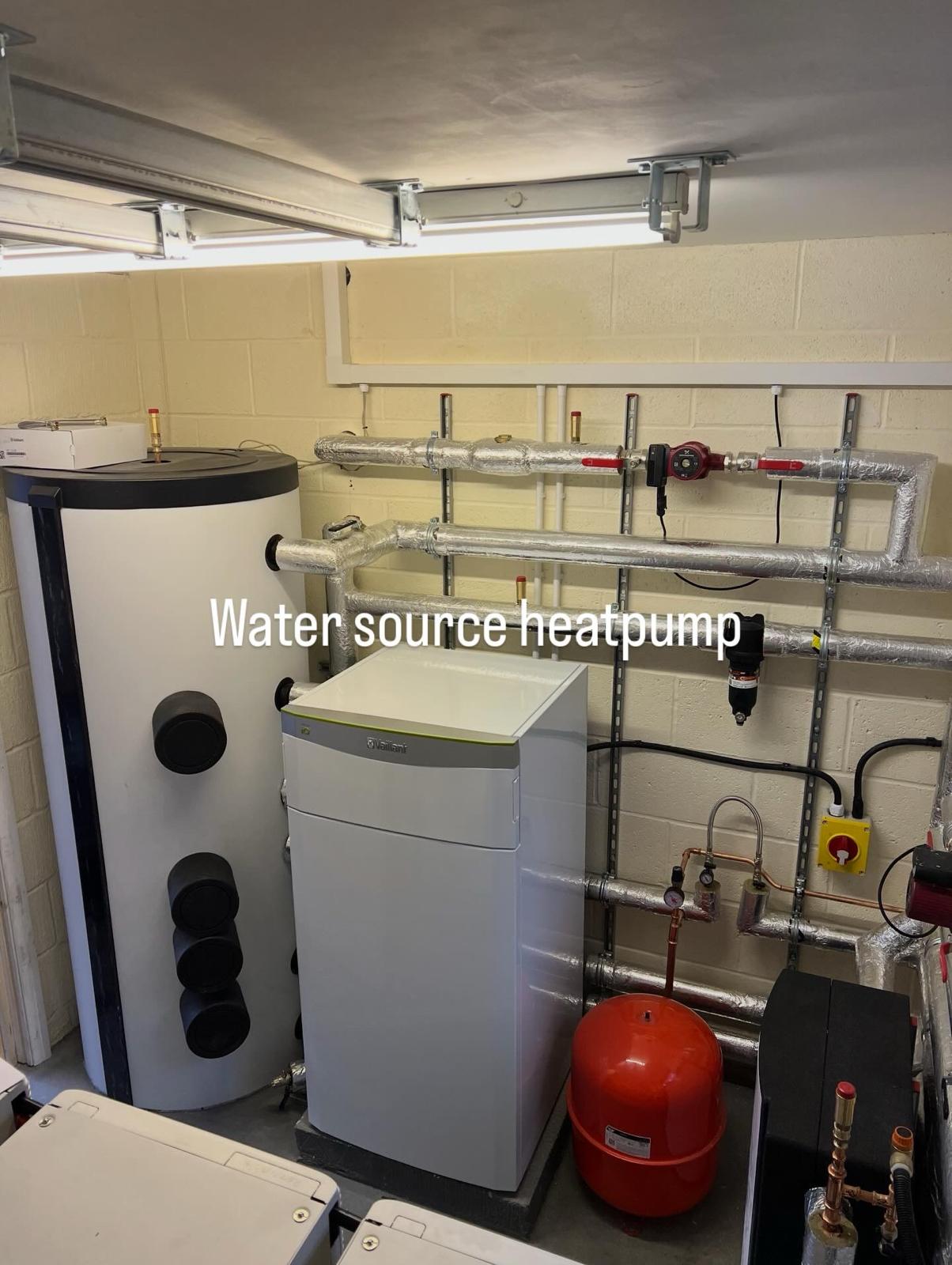
I recommended and installed a 19kw Vaillant Flexotherm water source heat pump. The system is cleverly designed so that the heat pump draws its energy from the brook that flows through the client’s garden. We extract water from the brook into a holding tank then pump this water across a plate heat exchanger from which the heat pump draws its energy. The heat pump stores its energy in a large buffer cylinder which then feeds the individual systems when required. The system supplies the pool, UFH heating in the downstairs level, and radiators in the upstairs level.
The client was impressed with the depth of technical knowledge and expertise shown in the project, which required innovative problem-solving and the integration into the existing systems within the house and pool.
Which products did you select for the job and why?
The budget for the project was circa £25k for the heat pump installation and commissioning.
The 3-phase 19kw, Vaillant Flexotherm water source heat pump was chosen. Built from the ground up as a water source heat pump, it is a robust and reliable unit that performs very well across a broad temperature range.
A full Vaillant control system was used due to its flexibility of set-up and programming. It provides internet connectivity and remote monitoring capabilities plus a simple and user-friendly interface for the client. We will monitor the system performance and any changes or improvements to drive further efficiencies will be applied. Vaillant also provides a good quality after care and warranty scheme for the client. Its technical helpline is particularly good.
All sizes of pipework (15mm – 42 mm) was completed using copper press fit. I have used copper-press fit for over 10 years as it allows for reliable, efficient installation without the need for any hot works, open flames or corrosive fluxes. All pipe support and clips were Hilti, due to the quality and flexibility they provide.
Grundfos pumps were selected due to their reliability and large product range.
Planning required full heat loss and flow calculations for all circuits (heating, brine, holding tank water and brook water supply to holding tank). The plant room layout was decided in real time on-site as it had to be planned around the battery storage and inverters, and existing swimming pool plant and equipment. All heat calcs were done on a spreadsheet, taking into consideration all aspects of the project, and the fact the property was relatively new.
Tell us what was different or unique/challenging
We had to work within the constraints of the existing system. The customer didn’t want to change their controls, and the pool controls were fixed, so we had to design a solution that could integrate seamlessly with what was already in place. Additionally, the property featured designer radiators, and the client was keen to retain them, so we carefully sized the heat pump to ensure it could operate effectively with the existing emitters without requiring major alterations.
Using the brook as an energy source created an interesting and unusual project. It also presented its own unique challenges, with balancing and maintaining flow rates between the brook, the heat exchanger and the heat pump.
It was very satisfying removing a 60kw gas boiler and replacing it with a 19kw heat pump. The system will be cheaper to run than the old gas boiler and produce much less carbon. The integration with the battery storage and time-of-use tariffs will drive system running costs down even further, providing maximum efficiency for the client.
As mentioned above, the system comprises a large 241kw battery storage system (installed by others) which takes advantage of cheap, time of use electrical tariffs to charge the batteries which are then used to run the heat-pump during times of high grid demand and electricity unit cost. The battery system also allows the client to export excess energy back into the grid and claim a pence per Kw figure. This drives running costs even lower and the client has estimated a payback period of five years for the system as a whole. The heat pump will give a COP of between 3.5 and 6.5 depending on temperatures in and out of the unit.
The heating system is weather compensated for maximum efficiency during the winter months whilst the pool and air handling units will be run at a fixed temperature of 50C. The pool and air handler will run during the summer months only so the brook water into the heat pump will be at a higher temperature, which should even out the COP figures.
The project was completed during the months of December and January so the gas boiler had to be left operational for the customer to have heating in the house. The heat pump had to be installed, commissioned and tested with all flow rates set up and verified before the boiler could be removed. The boiler system and changeover to heat pump had to be completed in one day to a give continuity of heat for the customer over the winter period.
Despite these challenges, the end result was a simple, effective system that meets the property’s needs without unnecessary complication. The system has required no tweaks so far and is performing as intended, providing a reliable and more efficient solution for both the home and the pool.
Tell us what you learned and what you may do differently/apply to a job in future
It was an exciting and innovative project to complete and do so to a high standard. I enjoyed the problem-solving aspects of the project delivering the client brief for efficiently heating a large house and pool. The client now has a simple, easy-to-use system.
The Vaillant heat pump was easy to install and commission, the controls are very adaptable and allow control for multiple zones, circuits and temperatures, along with the integration of third-party controls where necessary – so I would use in future projects.
The customer wrote me a hand written letter to show their gratitude, which is written below:
“George, I wanted to show my appreciation for your fantastic work and for several problem-solving areas. I am impressed on the depth of your knowledge and expertise. Please enjoy a meal with your good wife. Regards, Liz and Keith

Qualifications
Extra training and/or CPD you’ve done in the past 12 months
I place a strong emphasis on ongoing training and individual development. Heating and renewables are constantly evolving, and I believe the best outcomes for my customers comes from keeping my knowledge and practical skills up to date. I also invest in training that allows me to expand the range of services I provide.
Over the past 12 months, I have committed several days to product and technical training, including:
Alongside training, I make a point of learning continuously throughout the year by listening to industry podcasts to stay connected to best practice, including Installd by Dominic Eves, Renewable Heating Hub – Homeowners Q&A by Mars Mlodzinski and BetaTalk by Nathan Gambling.
Please tell us about one or more projects you are particularly proud of
This project was for a returning client who asked us to deliver the full plumbing, heating, and fire sprinkler installation for their new family home. The property is a 161m² timber-frame new-build bungalow. Initially, the client was unsure whether to install a gas boiler or an air source heat pump, but after several discussions and reassurance around performance, efficiency, and running costs, they chose to proceed with a heat pump based on our recommendation. The home was also being fitted with 10kW of solar PV and a 10kW battery system to further improve overall efficiency.
I initially carried out a full heat loss assessment using heat engineer software, which confirmed a design heat loss of 5.85kW at -3.99°C, based on an internal room temperature of 21°C.
The client requested underfloor heating throughout the property with no radiators, so I completed the system design based on a 35°C flow temperature, a DT of 5°C, and a 32.5°C mean water temperature (MWT). The design also accounted for hardwood flooring as the final floor finish.
I sized the primary pipework using the IMI HyTools app, which confirmed 28mm copper as the most suitable option, with a calculated pressure loss of 147 Pa/m and a velocity of 0.52 m/s. I then calculated the pressure loss across the index circuit, ensuring the pump had sufficient available head to overcome the total resistance. By adding together the losses from the primary flow and return pipework, fittings, valves and the highest-resistance UFH loop
Which products did you select for the job and why?
After completing the full heat loss assessment and system design, I began by installing the underfloor heating. Once the screed had been poured, I installed the heating supply pipework and insulation. I then completed the installation by fitting the plant.
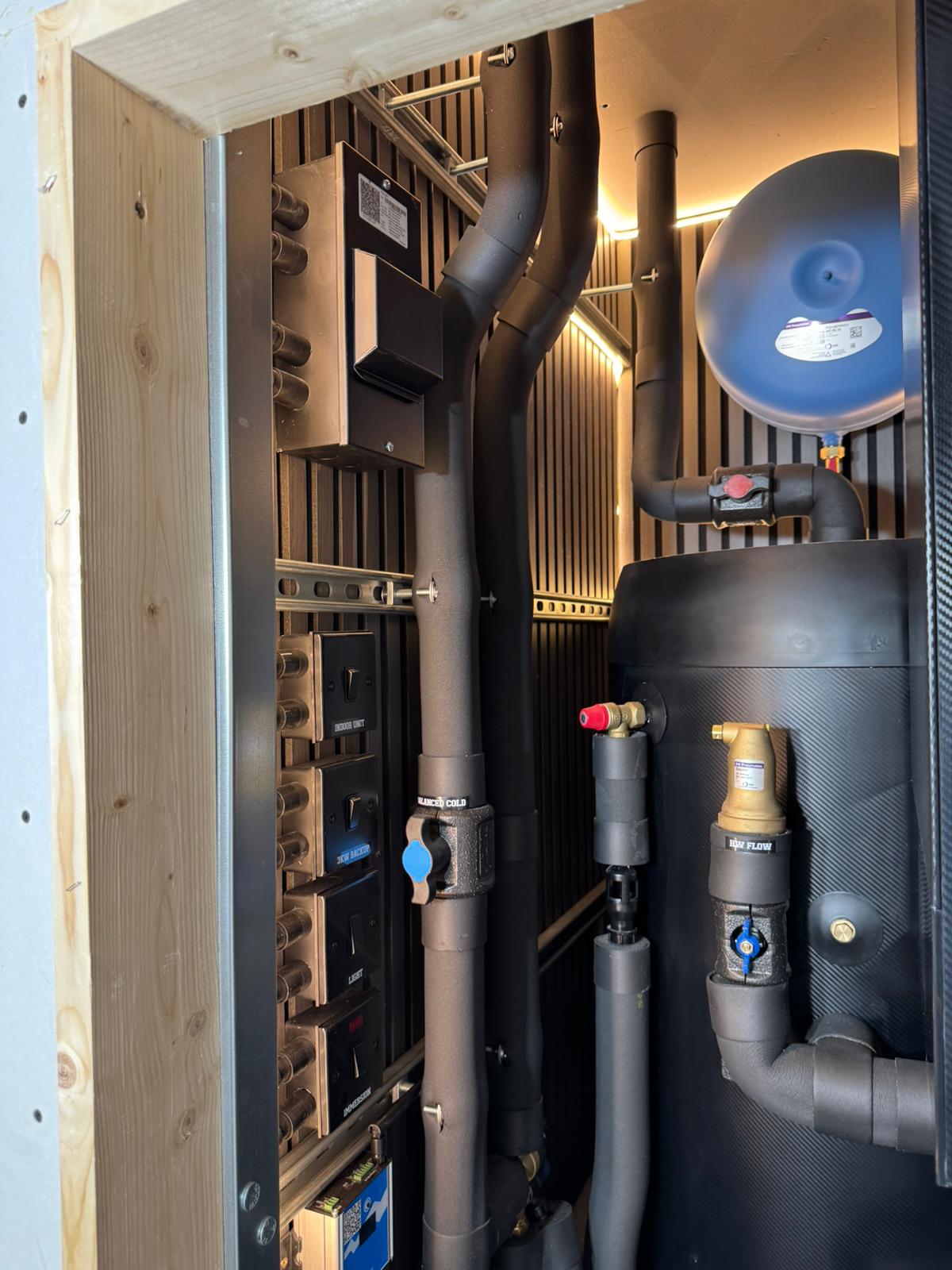
The client wanted a heat pump that would deliver reliable performance and high efficiency, so I selected the Viessmann Vitocal 150-A 8kW. This model provides 6.58kW at –3.99°C, meeting the property’s design requirements. I also chose the Viessmann due to its unique ability to use an internal buffer for defrost cycles. We built the buffer into the internal unit that was positioned in the airing.
To provide domestic hot water, I selected an OSO Delta GeoCoil 300-litre cylinder. It’s one of our preferred cylinders due to its reliability and A-rated efficiency. I specified the 300-litre capacity to suit a household of four, with high-demand fixtures including large rain-head showers and a bath.
Externally, I used Primary Pro insulation and Pump House 140mm trunking to protect the pipework, sealing all joints with the manufacturer’s recommended sealant.
Within the airing cupboard, I used copper pipework with M-Press fittings. I also installed an Impel fill and flush valve with an integrated magnet and strainer, chosen for its insulated shell and the convenience of combining both components in one unit.
I also installed an Elexion MiniView 360 top-up unit to allow safe, controlled filling in the future. As the local water supply is soft, I was able to use this unit to fill the heating system during commissioning, rather than using a separate filling unit. I then tested the system water using a ThroughFlush water analysis kit, recording the following results: conductivity 100 µS/cm, hardness 60 ppm, and pH 8.6.
I used 19mm k flex insulation to insulate all pipework ensuring to tape all joints, Giacomini isolation valves with insulation shells and IMI Zeparo Air Vents on the primary pipework high point and also the hot water cylinders flow pipework.
Tell us what was different or unique/challenging
This was one of my most enjoyable projects, as the client gave me full trust and freedom to specify and install the solution, I felt best met their needs and requirements, it was also a great opportunity to showcase what we’re capable of and to provide future customers with real proof of how efficient and effective heat pumps can be when they’re properly designed and installed. For that reason, I wanted to create something a bit special for the client, so I fitted acoustic panels inside the airing cupboard along with LED lighting, and finished the Viessmann Vitocal 150-A indoor unit and hot water cylinder with a carbon fibre vinyl wrap.
The client absolutely loved the finish, but it wasn’t just about visual impact. I also fitted the system with remote monitoring via OpenEnergyMonitor, allowing us to track performance and demonstrate the heat pump’s efficiency.
The client also had 10kW of solar PV and a 10kW battery installed, helping to keep running costs low. This was installed by the onsite electrician that the customer provided, and it was a problem free install that didn’t take too long. The heat pump is currently operating with a SCOP of 4.6.
I also advised the client to review their electricity tariff, as it is fixed until May 2026 at 35p/kWh, which is relatively high. Moving to a more suitable tariff should reduce running costs even further. This also made them investigate the electrical tariffs for their business and found that to be 40p/kWh which they have since changed to a new tariff of 28p/kWh.
Over the 4 weeks, it was great to see the client’s journey, from being sceptical about whether it was the right decision to becoming fully invested, confident it would work, and genuinely interested in how the system operates. Nothing demonstrated this more than the fact the property had already been fitted with LPG pipework only for the client to later say, “We don’t need that anymore, can you cap it off?”
Thanks to the thorough design and plan, there were no major difficulties on site, aside from the challenge of fitting all the required components neatly within the airing cupboard
Tell us what you learned and what you may do differently/apply to a job in future
This project reinforced the importance of carrying out a full design to ensure a successful, efficient and reliable heating system. I have a clear process now in place to undertake similar jobs from start to finish and how to carry out those processes efficiently.
As this was our first Viessmann Vitocal heat pump installation, I allowed extra time to familiarise ourselves with Viessmann’s specific controls and commissioning process to ensure everything was set up correctly. This has given us valuable knowledge that I can apply to future installs.
As the client wasn’t eligible for the BUS grant, as the property was connected to the caravan park (business) so it didn’t qualify. It was great to see them embrace the technology regardless. With the alternative heat source being an LPG boiler, I calculated the heat pump’s annual running costs would be approximately half. Based on that saving, I expect the additional installation cost to be recovered within around four years.
Qualifications
Extra training and/or CPD you’ve done in the past 12 months
I have completed training courses on:
Excited to do solar thermal when we have time.
Please tell us about one or more projects you are particularly proud of
The project I would like to enter is the installation of a heat pump, solar PV, and battery system in a 325-year-old Grade II listed cottage. The aim was to replace a noisy oil boiler with a low-carbon heating solution while carefully preserving the character of the building.
The property was owned by a young couple who were very keen to explore renewable energy. They had already spent time researching their options and were particularly interested in installing a heat pump, despite the property not being a typical candidate for this type of system. They were therefore looking for an installer who was open-minded and willing to take on a more challenging project. I guided them with the BUS grant, and helped them with planning permission too.
While the client came to us with a clear vision for incorporating renewable technologies, I played a key role in guiding them on how best to implement the system. This ensured the solution was not only practical and efficient but also sympathetic to the age and constraints of the building.
This project was delivered by myself and my partner, both in life and in business, and our combined skill sets allowed us to achieve a high-quality result. My partner is a fully qualified engineer with two degrees, and they played a key role in carrying out and refining the heat loss calculations, as well as optimising pipe runs to ensure both efficiency and a more visually appealing installation. This collaborative approach meant we could balance technical performance with aesthetics throughout the design process. I took the lead on the plant room installation, ensuring it was built to a high standard and operated efficiently.
Due to the property being without heating for two weeks during the works, and the cold conditions at the time, it was essential that we worked efficiently and cohesively to complete the installation as quickly as possible without compromising on quality. Our ability to plan, communicate, and support each other throughout the project highlights the strength of our partnership and our commitment to delivering excellent results.
A key aim of the project was to upgrade heating and hot water without compromising the internal aesthetics. With no wall cavities and very limited service routes, every detail was carefully planned to ensure the new system blended in sympathetically. In several rooms we were able to reduce, rather than increase, the amount of visible pipework. Radiators were replaced where required, selecting styles and positions that suited the cottage and improved comfort.
The original oil boiler was centrally located and loud enough to wake the owner each morning. It was also oversized, meaning the cottage heated too quickly and made it difficult to maintain a stable, comfortable temperature.
Working closely with the customer, we identified discreet installation routes that avoided visual clutter and preserved the building’s charm. This improved the layout of several rooms and resulted in a system that looks neat, intentional and unobtrusive.
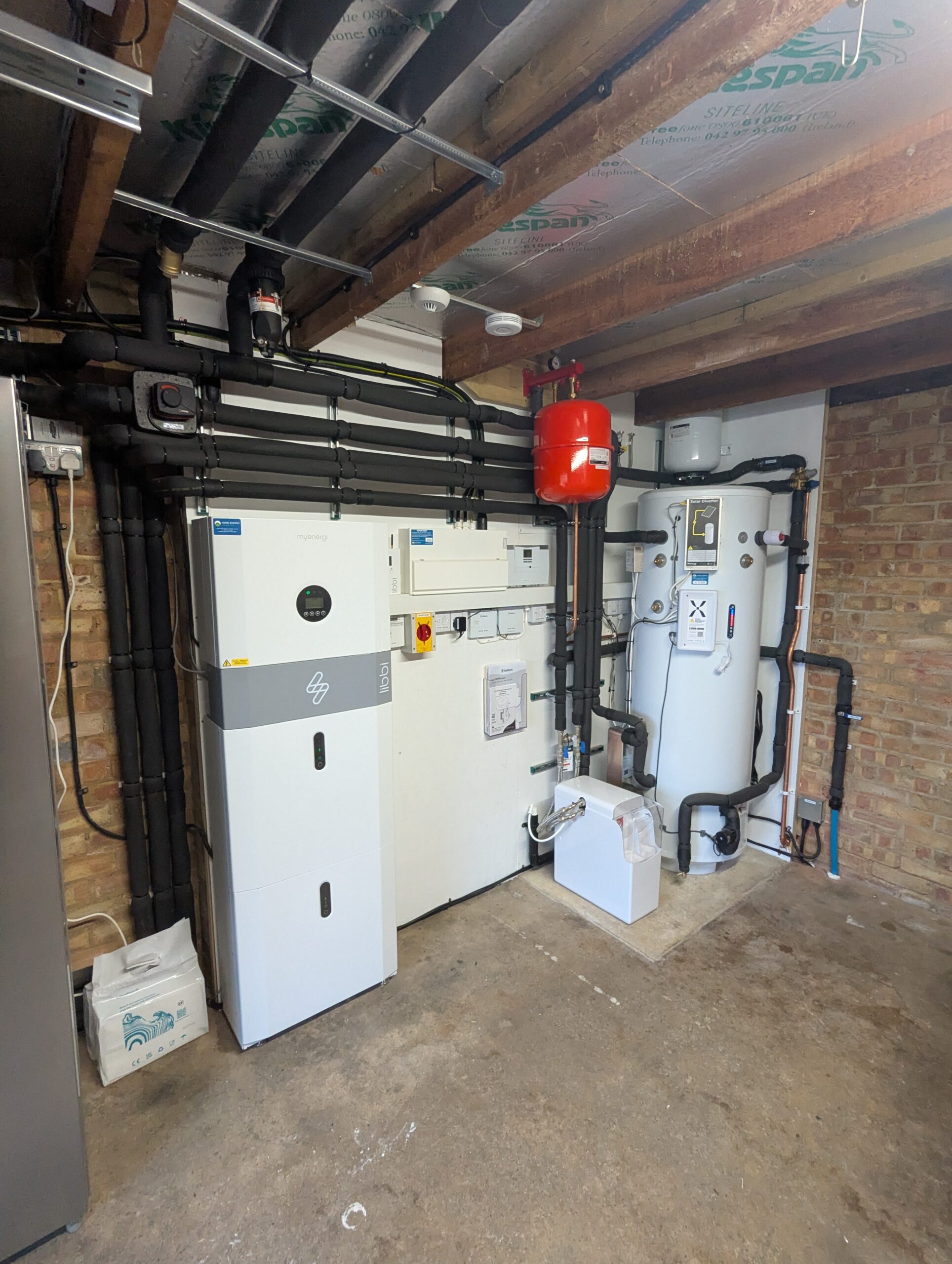
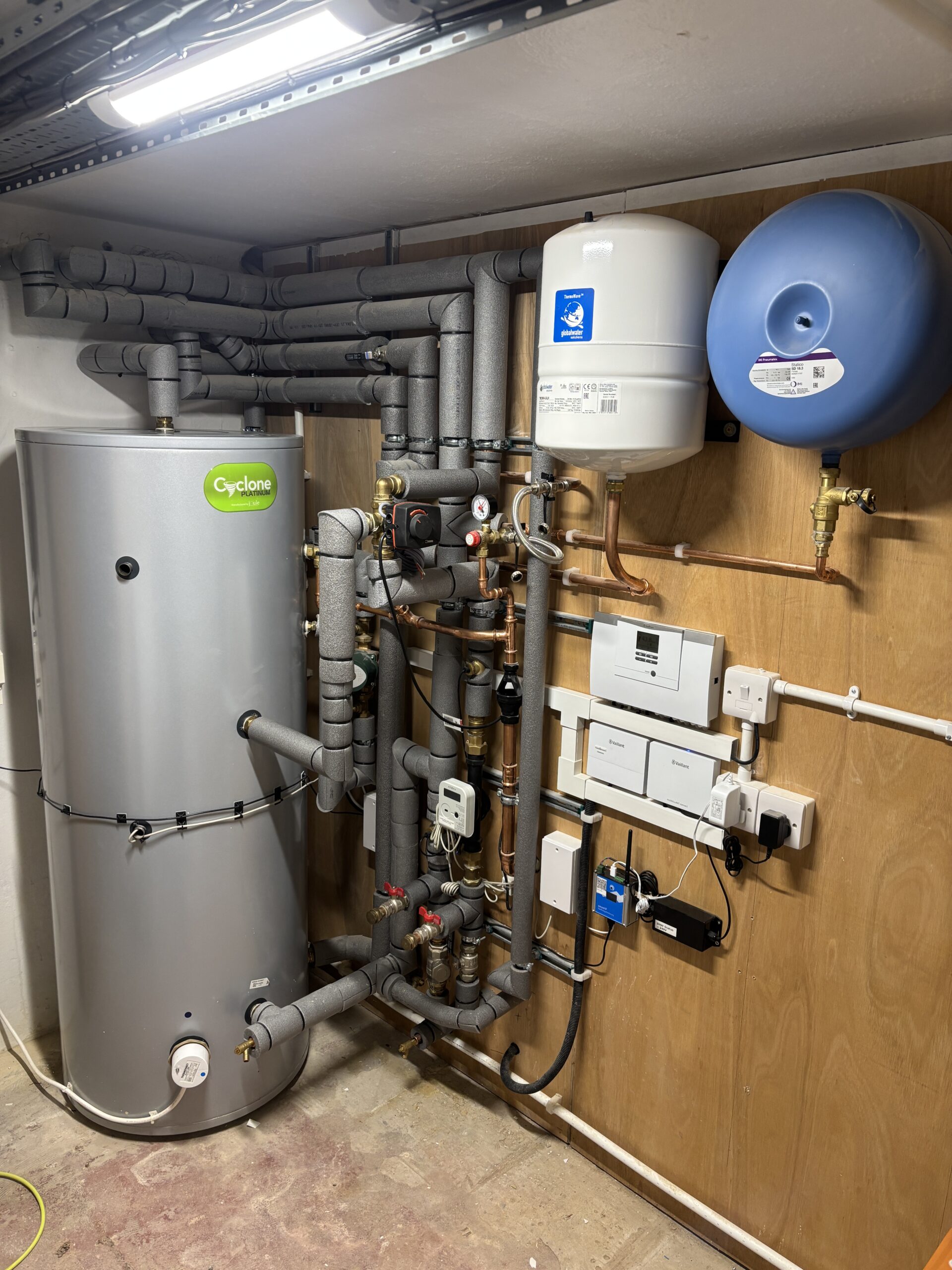
All key components – including the hot water cylinder, battery system and control equipment – were relocated to the garage, creating a tidy and accessible “energy hub” and freeing up valuable internal space. The external Vaillant heat pump operates extremely quietly.
To further improve efficiency and reduce running costs, solar PV was installed on the outbuilding, a MyEnergi battery system was added to store cheap or self-generated electricity, and a Mixergy smart hot water cylinder was installed to provide highly efficient, on-demand hot water.
Which products did you select for the job and why?
Vaillant aroTHERM plus 12kW heat pump – chosen for strong domestic hot water performance, quiet operation and suitability for a period property where comfort and correct sizing were essential. The customer was familiar with the brand and we have had consistently good results on previous installations. Vaillant’s technical support, warranty and straightforward commissioning also made it a reliable choice. It was the right choice for the property as any smaller, it wouldn’t have been able to warm them on colder days and vice versa if it was larger. This system was a perfect fit for the house.
Mixergy 250L Solar X cylinder (with heat pump kit) – selected to improve hot water efficiency and maximise the benefit of smart tariffs and solar PV. Mixergy’s top-down heating and strong thermocline means only the required volume of water is heated, reducing wasted energy. It also enables flexible control to prioritise cheap-rate electricity or solar surplus. Planning and system design was done for everything, although the customer wanted the renewable energy we still guided them on the most efficient sytem. We advised on the location of the solar which was on the shed roof. As though not to destroy the historic nature of the property and adhere to planning permission. We always try to save the customer as much money as possible where we can.
An ESBE diverter valve chosen for quiet operation at higher flow rates and low resistance, supporting stable system flow and efficient heat pump operation.
Harvey TwinTec water softener was selected to protect the cylinder, valves and pipework from limescale. It is non-electric, uses less salt than many alternatives, and wastes less water during regeneration, reducing maintenance and running costs.
Mixergy smart hot water cylinder was installed to provide highly efficient, on-demand hot water. It works to provide the customer with the cheapest source of energy, communicating with all three sources to swap between the three.
A myenergi Libbi battery system was chosen for value, ease of installation and integration with the existing myenergi EV charger. It allows greater use of cheap-rate electricity in winter and storage of solar generation in summer, reducing grid import and running costs.
The customer’s priority was achieving the right long-term solution rather than focusing on the lowest upfront cost. We worked closely with them to design a system that suited the constraints of a Grade II listed cottage, ensuring the character of the property was preserved. Radiator selection and positioning were carefully reviewed on a room-by-room basis, often favouring smaller, well-positioned radiators that were less visually intrusive. We selected Stelrad radiators for their proven quality and performance, alongside Drayton TRVs, allowing for effective temperature control while maintaining efficiency and comfort throughout the property.
Pipework routes were carefully planned before work began, ensuring minimal disruption to the historic fabric of the building. Where appropriate, we chose to run neat, exposed pipework rather than chasing into walls, preserving the integrity of the property while maintaining a high standard of appearance.
All pipework was installed in copper, using Lawton tubes, as this provided the best combination of durability and visual quality as much of the system was on show. Due to the higher heat loss associated with the property, we utilised larger pipe sizes, including 35mm and then 15mm, 22mm, 28mm, and, to ensure the system could operate efficiently and deliver the required performance. We deliberately avoided the use of plastic pipework, opting instead for copper for superior aesthetics.
We selected Vaillant controls for this project as they integrate effectively with the heat pump system, helping to maximise overall efficiency. They are also highly user-friendly, making it easier for the homeowner to understand and manage their heating system, which was an important consideration for long-term performance and usability.
Tell us what was different or unique/challenging
As with many older properties, the existing heating system had evolved over time without an overall plan. This resulted in unnecessary pipework, poor system layout and components located in inconvenient positions. The oil boiler was installed centrally in the house and was loud enough to wake the customer each morning when it fired. Moving to an external heat pump immediately reduced internal noise and improved the customer’s day-to-day comfort.
The previous heating strategy relied on running the system very hot for short periods, then allowing the property to cool down. This created an uncomfortable cycle of overheating followed by cold spells. The new system runs at low temperature with weather compensation, delivering stable comfort throughout the day. The home now maintains a consistent 21°C during the day and 19°C overnight, with far better control and a noticeably improved living environment.
Hot water was also a challenge. The original system was vented, with limited hot water duration and poor pressure, and the cylinder was again located in the middle of the house. We relocated the hot water system to the garage, freeing up valuable internal space for the customer to convert into a bathroom. A larger cylinder was installed, improving shower duration and pressure. We also rerouted pipework so the cylinder is closer to the most frequently used outlets, reducing hot water draw-off time and improving efficiency.
Much of the original system was end-of-life, with corroded radiators and an ageing boiler. The new low-temperature heating system provides a long-term solution, removing reliance on oil deliveries and allowing the customer to use a proportion of their own solar generation to run the home.
Despite the cottage being relatively small, we successfully integrated a heat pump, smart hot water cylinder, solar PV, and battery storage system. This project demonstrates that a full renewable upgrade is achievable even within a listed period property where space is limited.
The heat pump operates at up to 570% efficiency, significantly reducing energy demand compared to traditional systems. The system is further optimised by being linked to the battery storage, which is charged overnight using a lower-cost off-peak tariff, the same tariff the homeowner uses for their electric vehicle. This approach allows the customer to maximise efficiency while minimising running costs.
As a result, the homeowner has achieved substantial savings, particularly compared to their previous reliance on direct electric heating, making the system both environmentally and financially beneficial.
Tell us what you learned and what you may do differently/apply to a job in future
This project reinforced the importance of considering plant room temperature and heat loss in outbuildings. Although relocating the system to the garage created an excellent, accessible “energy hub”, the space is colder than expected. In hindsight, we would specify thicker pipe insulation throughout. The customer is planning to build an insulated partition within the garage, which will further improve efficiency and reduce heat loss. We did add insulation at the time, but due to the customers budget, it couldn’t be done the scale we needed it to be at the time, so we advised for it to be done as soon as possible.
The project also gave us valuable experience with the Mixergy cylinder. It is an innovative product and the customer is very happy with the performance. However, for this particular property and usage pattern, a more conventional cylinder paired with a myenergi Eddi may have been a simpler and more cost-effective solution while still achieving excellent results.
Finally, we found that upsizing several primary components (including the filter, strainer and 3-port valve) helped achieve higher flow rates and improved overall system performance. This was not part of the original specification, but we made the decision on-site in the customer’s best interest and did not pass on the additional cost.
The customer is super happy with the results, especially as they did so much research. It has also led to family and friends converting to heat pumps in their own properties. As well as other customers. We have used it as a case study of success on our website.
Qualifications
Extra training and/or CPD you’ve done in the past 12 months
Please tell us about one or more projects you are particularly proud of
I am particularly proud of my project at Old Lifeboat House. The customer had purchased a 250m2 property in an exposed location on Lancing beach, and was carrying out major renovation works, converting what was essentially a single floor property with a neglected basement level, into a 3-storey beach home with loft conversion. As part of these works Ed wanted an air source heat pump system with UFH on the middle floor, and radiators on top and bottom floors.
The house was a real design challenge, with each floor having very different characteristics. The whole building was rather unusually made of solid concrete. The basement was half sunk into the ground; the ground floor was relatively conventional in the sense that it had normal (although solid concrete) external walls but half of the floor was above basement and the other half above an unheated solid concrete crawl space; and the top floor was a typical modern loft conversion. Insulation was added on the inside of the walls throughout. Insulation was added as the customer wanted to make the house as efficient as possible, so insulation was added wherever it could be. Trying to calculate U Values for solid concrete with insulation added, and deciding how to treat walls that were partially buried under ground and floors with differing ‘other sides’ was a real challenge.
The ground floor required UFH, and was set to use a variety of different floor coverings from 0 tog tile to 0.25 tog engineered wood to 1.5 tog carpet. The floor was also uneven and slightly off level. To add to this, there were different room types across the floor, and the customer desired different design temperatures in each, with 19C in bedrooms and 21C in living areas and bathrooms. It was clear that an overlay product with set pipe spacings would not deliver the variety of output needed, and a typical screed system would raise the floor too much.
We needed custom pipe spacings in a low-profile screed. Using the traditional ‘method’ of installing thermostats in every room to limit the temperature was out of the question as heat pumps need volume and flow rate. We created an open-link design, which allowed us to keep the flow temperature low for the property, making it more efficient overall.
Which products did you select for the job and why?
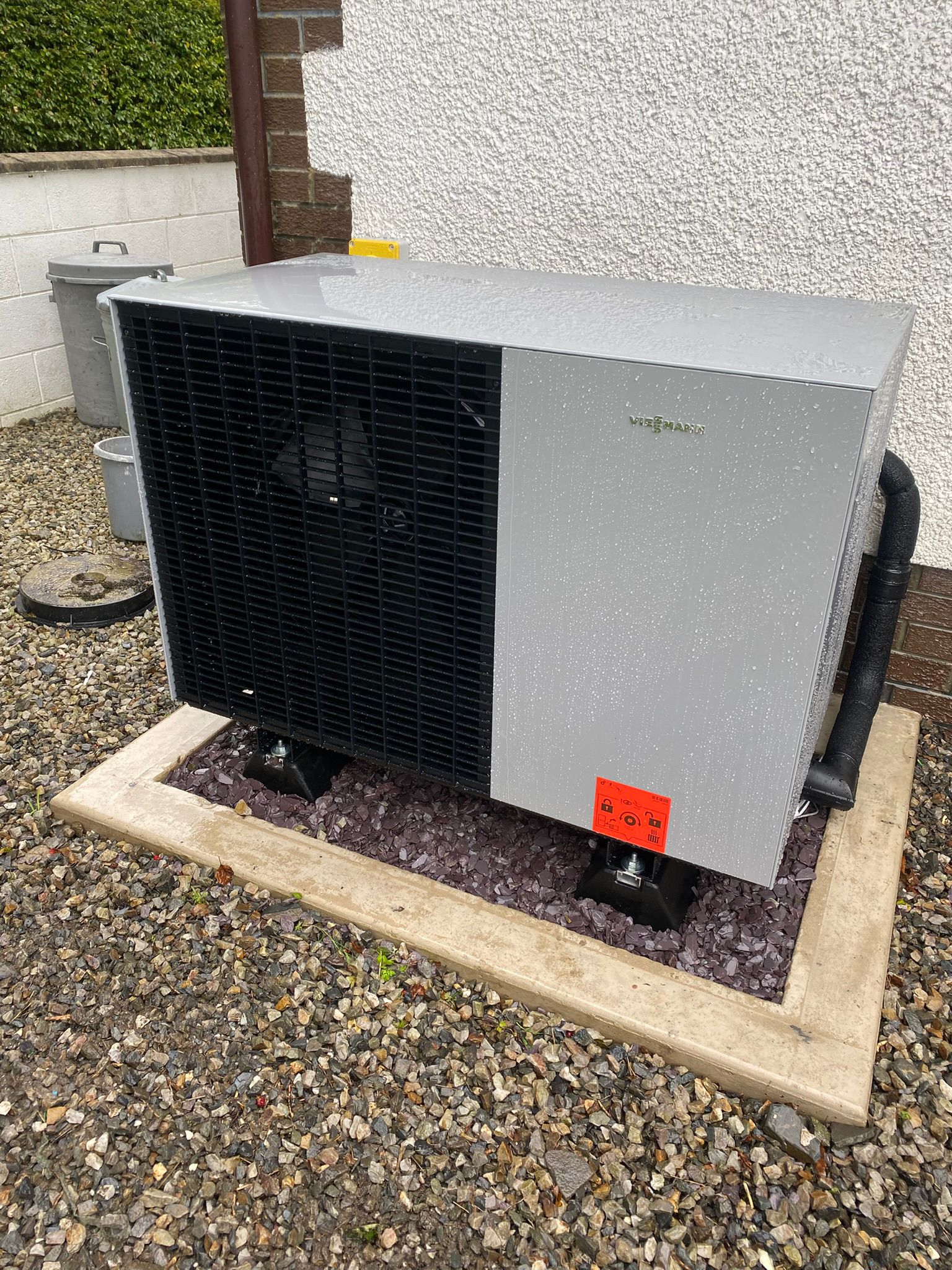
We used the Heat Geek software to calculate the heat loss of the property, which was 8.11 Kw. We use the heat geek software because it builds 3D models of the rooms, which is great for taking measurements. We specified a Vaillant Arotherm Plus 10kW heat pump which is a very efficient unit due to its large evaporator coil. We could have chosen a 7Kw model, but the 10kw was the more efficient model for this customer. The customer is a data nerd and a clever-clogs who is confident reading data, so I chose Open Energy Monitor heat pump monitoring for performance and efficiency visibility.
The heat pump came with a Vaillant SensoComfort thermostat for hot water and weather compensated heating control, and a Vaillant SensoNet to allow access to the system over the internet via the Vaillant app. Ed also has Home Assistant which he has managed to link to the Vaillant API for automated adjustments.
The DHW cylinder chosen was a Joule Cylclone Plus 250L combined with a DAB bronze circulator. Joule is an extremely good manufacturer and based in Ireland which is reasonably local. DAB are Italian so this is at least on the same continent, but fundamentally, it’s good equipment. This was paired with a Drayton pipe stat and lots of pipework insulation to keep the energy efficiency of the secondary return circuit as high as possible.
The diverter valve is made by Sweden’s best, ESBE. The VRG range provides high quality motoring and shut off with a high KVs value of 16 keeping the system resistance to a miminum and maximising circulation.
On that note, I specified MLCP pipework throughout, with each floor piped independently back to the plant room in 20 and 25mm circuits, to maximise circulation and ease balancing. All visible pipework was copper end feed except for the plant room which was press-fit and fully insulated in Climaflex. This is because, in a plant room, we always rigid copper, however, MLCP is flexible and comes in long length which makes it more useful for rest of the system.
Emitter circuits were Purmo Compact radiators on the top floor and basement. A UK manufacturer for maximum sustainability and quality. UK company Multipipe were used for the UFH, with their pipe positioning panels allowing custom spacing and low resistance 16mm pipe. This made a low profile screed possible and cost effective. A Monarch Midi water softener was fitted for scale protection.
The budget for the renovation was 34k, part funded by the BUS grant, which we organised for the customer in partnership with Heat Geek.
Tell us what was different or unique/challenging
The build of the property was extremely unique. We were essentially turning a cold, brutalist concrete structure, into a place of comfort. There was a mix of exterior above ground walls and floors, exterior below ground walls and floors, intermediate floors, various insulation thicknesses added to existing structure, different floor coverings, different room temperatures and different emitters.
It would’ve been easy to take a standard approach of installing a single output of system throughout then regulating room temperatures with stats and TRVs. This would’ve strangled the heat pump flow rate, increasing cycling and lowering efficiency, which would’ve required a buffer and pumps installing, possibly mixers, adding cost and reducing appliance performance.
This project pushed me to calculate a huge amount of variables if I was to deliver the desired temperatures throughout without detriment to the heat pump. I was proud to be able to deliver this system open loop with no buffer. Simplicity is not easy.
The system has been running since Summer 2025 and is performing excellently. Open Energy Monitor was connected in December, and the average efficiency of the 3-month winter period is 468% which is outstanding. Please see a testimonial from the client below:
“I have long been interested in heat pumps and other renewable technologies. So, when I purchased a 1920s house in need of renovation, I had a chance to convert to an all-electric house with a heat pump. I understood how they worked, what a proper heat loss calculation looked like and what the important considerations were. So, when I say this installer impressed me, I mean it.
Every question I asked was answered with consideration. The system was designed properly for my home. The installation was clean, well thought through, and clearly done by a team who cared about the quality of their work.
The results back that up. My system is running at a SCOP of over 5, which is genuinely exceptional and only achievable when the design and installation are done correctly from the start.
I went in with high expectations and they were met. I’d recommend this installer without any hesitation and I’m happy to support their nomination for the Heating Installer Awards 2026.”
I overcame the challenges of different floor coverings and room temperatures by specifying four different pipe spacings from 100mm to 300mm, and with some balancing on the manifold, the ground floor is exactly where it needs to be, and Ed is a happy customer. It is truly vindicating to see that going the extra mile with the heat loss calculation and emitter design pays dividends in the outcome.
Tell us what you learned and what you may do differently/apply to a job in future
I learned a great deal on this project. One thing was that you need to allow for a lot more core bits when drilling dozens of holes through concrete structures! On a more serious note, I learned that there are shortcomings in heat loss methodology.
The basement level radiators have turned out to be oversized and required a lot of balancing down to achieve target room temperatures. This is due to the following calculation errors:
The customer also set up Home Assistant to increase the curve of the heat pump weather compensation when the wind speed is above a given value to resolve issues with exposed location and air infiltration. Amazing! We learn from customers too.

Qualifications
Extra training and/or CPD you’ve done in the past 12 months
Over the past year I’ve made a big effort to focus on CPD that genuinely improves my engineering work. I attended several trade shows and deliberately avoided the sales pitch side of things – instead I spent most of my time talking to the technical teams and the engineers who design the products. Those conversations gave me real insight into how different boilers, pumps, valves and controls behave in difficult conditions, which directly influences how I design systems for older buildings.
I have also visited two manufacturing facilities this year. Seeing how components are assembled, tested and stress-checked was a huge eye-opener. It helped me understand the small details that make one product reliable and another one problematic, especially on remote jobs where reliability really matters.
A lot of my CPD this year has been self-driven too. I’ve been documenting more of my work, analysing system performance, learning from real installations, and sharing those lessons in a few industry podcasts. I was also asked to contribute to a new heat pump book written by over 30 engineers. My section is about ECO-scheme installs and the red flags homeowners should watch for. This is something I feel strongly about because poor ECO4 work is damaging trust in our trade.
On the regulatory side, I completed my Gas ACS 5-year reassessment and passed both my annual Gas Safe and OFTEC inspections, keeping all my qualifications current and compliant.
Please tell us about one or more projects you are particularly proud of
One project I’m especially proud of was replacing the full plumbing and heating system in a 122m2, three-bedroom, two-bathroom, 1980s bungalow. The homeowner was hesitant about installing a heat pump due to negative experiences she’d heard about, and her biggest concern was that the house would feel cold. My goal was to design a system that was efficient, quiet, reliable, and consistently comfortable. The outcome of this project made me particularly proud because the customer fully trusted my recommendation for the heat pump and I was able to educate her. I could tell that she was eager to see the outcome and ensure she felt comfortable in her renovated home. Seeing her now that the pump is installed, in a warm and comfortable home and being such a supporter of heat pumps, feels really rewarding.
The property had poor thermal performance: original pipework buried in the slab, uninsulated walls, and inadequate loft insulation. Even though insulation upgrades weren’t required for the Boiler Upgrade Scheme (BUS), I follow a fabric-first approach because improving the building envelope is the best way to reduce energy use and maximise heat pump efficiency.
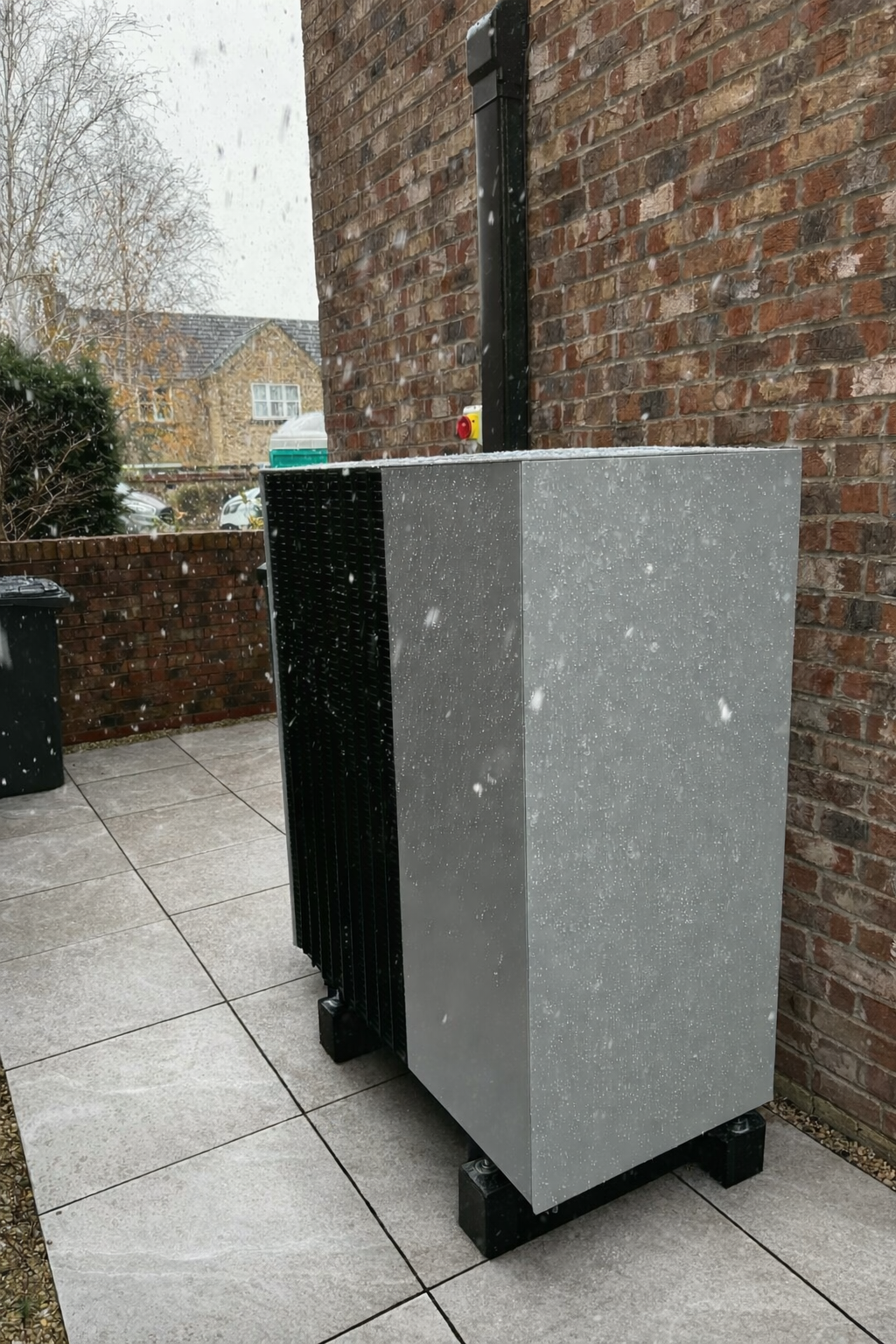
I improved the wall U-value from 0.6 to 0.18 W/m²·K and upgraded the loft to 0.12 W/m²·K cutting overall heat loss by around 40% and enabled a low-temperature system. Using accurate heat-loss calculations of 36.7 watts per m2, I specified a 6 kW Viessmann Vitocal 151-A heat pump for its strong low-temperature performance and very low noise, paired with a Viessmann integrated cylinder to save space.
The system was designed for ultra-low flow temperatures. Oversized Stelrad radiators, FRV flow-regulating valves, and a balanced open-loop layout ensured even heat distribution. Primary pipework was oversized to maintain mass flow without extra pumps. I used VDI 2035-compliant water, an IntaKlean HP filter, and an IMI Zeparo deaerator to protect long-term system health. The final system achieves a 42°C flow at –1.5°C outdoors and around 31°C for most of the year (based on historic average outside temperature data). This delivers excellent efficiency and the warm, steady comfort the homeowner was worried she wouldn’t get from a heat pump. The system is also as efficient and cost effective as possible to run whilst also focussing on sustainability.
Which products did you select for the job and why?
For this project, I chose components that offered the best mix of performance, reliability, and long-term value, with every item selected for a clear technical purpose.
The heat pump I chose was the Viessmann Vitocal 151-A (6 kW) because of its excellent low-temperature performance and very low noise, important as the outdoor unit sits near a bedroom. Its controls work perfectly with simple open-loop radiator circuits, avoiding the need for extra pumps or blending valves that contribute to efficiency loss. For the cylinder, I selected the Viessmann Integrated Unit because it is a compact unit with a high-efficiency coil that keeps the plant area tidy. Full integration with the heat pump improves reliability and makes commissioning straightforward. Crucially I wanted a product that had fantastic warranty and customer backup to support myself and my customer if there was ever a need to.
For the pipework, I chose 28 mm Copper and 32 mm Pre-insulated MLCP. Oversized primary pipework reduces resistance and maintains stable mass flow through the heat pump. The MLCP distribution pipe gives low heat loss, smooth internal bore, and strong durability for long bungalow runs.
The radiators I picked were Stelrad Softline. All radiators were oversized to achieve required outputs at ultra-low temperatures. Stelrad Softline units were chosen for accurate output data, reliability, and clean appearance.
Controls & System Protection:
• FRV valves for no guessing precise balancing.
• TRVs only in bedrooms to keep the main circuit unrestricted, offering an overheat control.
• IntaKlean HP filter to protect against magnetite.
• IMI Zeparo ZTVI deaerator to remove microbubbles and prevent noise.
• VDI 2035-compliant fill water for improved heat transfer and long-term protection.
A new, upgraded heating system was required on this project alongside a total renovation of the rest of the property. My budget was largely helped by a £7500 BUS grant that covered the cost of the heat pump and cylinder. This was one of the factors that helped me to persuade the customer to give this system a chance as the financial risk to her was reduced. Full heat-loss calculations guided sizing, mass-flow requirements, and the lowest achievable flow temperatures. A simple, efficient layout with no unnecessary components ensured a reliable, future-proof system delivered within budget with a focus on long-term value and efficiency.
Tell us what was different or unique/challenging
What made this project stand out was the chance to completely rethink how an older bungalow could be heated, while rebuilding the customer’s confidence in heat pump technology. She had heard so many negative stories that she was genuinely worried her home would be cold. Designing a low-temperature system that proved the opposite was one of the most rewarding parts of the job.
The bungalow presented several challenges: original pipework buried in the concrete slab, minimal insulation in walls, and inadequate loft insulation. Instead of simply fitting a heat pump, I took a fabric-first approach to conserve energy and guided the customer through the insulation upgrades. This cut heat loss by around 40% and allowed me to design a much more efficient system with a lower flow temperature.
A key part of the project was the precision engineering behind the hydraulics. I designed the entire system as an open-loop circuit, oversized all distribution pipework, and used FRV flow-regulating valves to perfectly balance the radiators. With the Viessmann integrated cylinder and its associated components, the pressure loss through the system is relatively high. As a result, it is often necessary to install a secondary pump and hydraulic separation to achieve the required flow rates to the heating circuit. Hydraulic separation can reduce overall efficiency due to mixing losses, as well as the additional electrical consumption of a second circulation pump. This was something I designed the system to avoid.
By reducing the pressure drop across both the primary and secondary pipework, the required flow rates can be achieved without hydraulic separation, maintaining system efficiency and avoiding the need for additional pumping. These details aren’t always visible to the homeowner, but they make a huge difference to the day-to-day performance. Achieving a stable, unrestricted mass flow rate was essential to delivering ultra-low temperatures.
The results were clear. Even at the design outdoor temperature of –1.5°C, the system only needs a 42°C flow temperature to maintain 21°C indoors. For most of the year it runs at around 31°C, meaning the heat pump operates in its highest efficiency range almost continuously. The Viessmann heat pump has been commissioned to operate on pure weather compensation, with no additional control influence. The system continuously calculates the required flow temperature based solely on outdoor temperature feedback in order to maintain a stable indoor temperature of 21 °C.
Real-time modulation from weather compensation eliminates the time lag associated with traditional room thermostats, which rely on reactive on/off control, resulting in more stable internal conditions and improved overall efficiency.
Another important part of this project for me was the education opportunity. Not only educating the customer on heat pumps but also getting the carpenters more involved in heat loss consideration – to hear them talking about U values was quite a surprise but a really good example of the opportunity to educate and engage more professionals in the work we do. We have to influence at these points in time.
The final system is quiet, reliable, and extremely efficient, providing steady, gentle comfort. The customer told me she feels warmer now than she ever did with the old boiler – exactly the outcome I aim for. This project stands out because it combined detailed engineering, careful product selection, and a fabric-first strategy to show what a properly designed heat pump system can achieve.
Tell us what you learned and what you may do differently/apply to a job in future
This project reminded me how important clear communication, careful planning, and good system design really are. One of the biggest lessons was how much difference it makes to bring the customer along from the start. By talking her through the heat-loss calculations, the value of insulation, and why low flow temperatures matter, her doubt gradually turned into confidence. In future projects, I’ll strive to involve customers even earlier in the future so they understand the reasoning behind every decision.
Technically, the job reinforced just how crucial hydraulic precision is. The open-loop layout, oversized pipework, and FRV balancing worked exactly as planned, giving the heat pump a smooth, unrestricted circuit. Restricted mass flow is a heat pump’s enemy, as it restricts heat transfer and undermines efficient operation. Seeing the impact this had on low-temperature performance has made me even more committed to treating flow quality as the foundation of every renewable installation.
The project also showed how valuable fabric-first upgrades are, not just for efficiency, but for long-term comfort. Even relatively small insulation improvements made a noticeable difference to heat demand. I’ll continue encouraging customers to consider investing in these upgrades because the long-term benefits are so strong.
Finally, the installation highlighted the value of keeping things simple. Avoiding unnecessary components like buffers or extra pumps saved money and improved reliability. I plan to keep focusing on clean, straightforward system designs that let heat pumps work exactly as they should.
Overall, this project reinforced the importance of good communication, thoughtful engineering, and a fabric-first mindset, principles I’ll carry into every future installation.

Qualifications
Extra training and/or CPD you’ve done in the past 12 months
In the past year, most of my learning has come from hands-on experience on the jobs I’ve completed. I’ve been able to draw a lot on the previous manufacturer training I have attended in previous years too. While I have not completed further formal training courses in the last year, I regularly build on my knowledge through practical application and ongoing learning.
A key influence on my work has been the Heat Geek approach to system design, which has helped me develop a strong understanding of how to design and install efficient heating systems, particularly when working with heat pumps. I have also previously completed a Vaillant course focused on system updates and product knowledge, as well as a Worcester Bosch heat pump training course around a year ago. I’m able to use learnings from these courses on a daily basis.
When I encounter something unfamiliar on a job, I will contact technical support or refer to manufacturer guidance to ensure I am following best practice. This allows me to keep learning in real time and apply the most current knowledge to my jobs.
I’ll be attending an OSO Hotwater factory tour in April, which I’m looking forward to as it will give me further insight into product design and manufacturing processes.
Please tell us about one or more projects you are particularly proud of
This project evolved from a long-term service relationship into a complete heating system transformation for a fully detached, early-2000s six-bedroom property. There are two people living in the property full-time, however they frequently host family members so there can easily be seven people staying in the property over the festive period, for example.
I had maintained the existing Ideal Classic boiler for several years and was already familiar with the system’s limitations. The property was served by early non-barrier microbore pipework, which had led to severe magnetite contamination, poor circulation, and consistently cold radiators. A comprehensive power flush temporarily restored performance, but it was clear a full system redesign would eventually be required.
When the time came to consider replacement, the homeowner was keen to invest in a heat pump. However, his wife had read numerous negative accounts online regarding poorly designed installations, high running costs, and underperforming systems. Reassurance was therefore just as important as engineering.
I carried out full room-by-room heat loss calculations and designed the system to operate at 40°C flow temperature at -3°C external conditions, ensuring the house could reliably maintain 21°C indoors even during peak winter demand. The design incorporated underfloor heating throughout the ground floor and correctly sized radiators upstairs.
A further challenge was that the existing ground floor was a concrete slab with no allowance for floor height build-up. I specified a routed underfloor heating solution, avoiding structural alterations while achieving low-temperature performance.
Hydraulically, the system was designed open loop to maximise water volume and avoid unnecessary buffers or secondary pumps. Two manifolds were installed to minimise pipe lengths and maintain available pump head.
Since commissioning, the property has remained consistently warm at 21°C throughout December and January, including during colder spells. The system is currently achieving a SCOP of approximately 4.1 (410% efficiency), validating the design strategy.
Over Christmas, with a full house of guests, there were no hot water shortages. The greatest problem was not simply technical it was confidence. Through detailed design, explanation and post-installation support, I delivered both performance and trust.
Which products did you select for the job and why?
Following full room-by-room heat loss calculations and emitter sizing, I selected the Viessmann Vitocal 150-A 13kW for this installation. This system consists of both internal and external units and was chosen for several technical and practical reasons. The internal hydraulic unit integrates key components required for efficient system operation, including:
One of the major technical advantages of this model is its defrost strategy. During colder conditions, when the external unit enters a defrost cycle, energy is drawn from the internal buffer rather than from the property’s heating circuit. This prevents any noticeable drop in internal comfort, ensuring stable indoor temperatures even during freezing conditions.
The control platform was another key factor. The unit offers advanced weather compensation logic, clear performance data feedback, and strong end-user compatibility. The interface is intuitive, modern and accessible for homeowners, which was especially important in this project due to initial hesitations around heat pump technology. Its sleek internal design also allowed it to integrate neatly within the limited 3m x 3m utility room space without appearing intrusive.
For domestic hot water production, I selected the OSO Delta Geocoil. This cylinder was chosen for its exceptional build quality and suitability for low-temperature heat pump operation. Key reasons included:
Radiators throughout the first floor were specified as Stelrad products, selected for their assured output accuracy and consistent manufacturing standards. Reliable output data is essential when designing at 40°C flow temperature, as oversights at low temperature have a significant impact on comfort.
Radiator valves were Altecnic Ecocall models, chosen for their solid construction and ease of fine balancing via the adjustable stem design.
Due to the high system water content created by combining underfloor heating and radiators, additional expansion capacity was required. This was supplied using equipment from IMI Hydronic Engineering to ensure stable system pressure under varying operating conditions.
The entire system was designed as an open-loop configuration. By carefully calculating hydraulic resistance and pipe lengths including installing two manifolds to reduce circuit resistance I was able to utilise the available head from the Viessmann’s internal circulation pump without adding low-loss headers, buffer tanks or secondary pumps. This reduced complexity, cost and potential inefficiency.
For the pipework, I used a combination of copper and MLCP, selecting high-quality materials such as Lawton Tubes and Yorkshire Copper Tube, alongside MLCP from Treetop. These materials were chosen to achieve the best possible performance, as they offer durability and are less prone to issues such as kinking. While MLCP can be more difficult to source locally in York, Treetop provides reliable access to both the pipe and the required fittings.
In terms of controls, the system benefits from integrated controls within the unit itself, meaning no additional external controls were required. However, I installed a room reference unit to provide reassurance to the homeowner, as they were more familiar with having a thermostat. This ensured both ease of use and customer confidence, while still maintaining the efficiency of the overall system design.
From a budgeting perspective, the project began with an agreed allocation for a heating system upgrade. However, as trust developed and renovation works expanded, the client increased the budget to incorporate wider property improvements. Transparent communication, staged cost discussions and careful planning ensured the project remained controlled despite scope expansion.
Planning involved close coordination with trusted local tradespeople I have collaborated with for many years. This ensured structural works, routed underfloor heating installation, and plant room integration progressed efficiently while maintaining high standards across all trades.
The product choices on this project were driven by performance, hydraulic simplicity, durability, and end-user experience ensuring not only efficiency on paper, but real-world comfort and confidence for the homeowner.
Tell us what was different or unique/challenging
What makes this project stand out is the combination of technical design, customer psychology, and long-term relationship building. It was not simply a heat pump installation, it was the transition of a household from uncertainty to complete confidence in low-temperature heating technology.
The most significant challenge was not pipework or plant space, it was perception. The homeowner was enthusiastic about installing a heat pump, but his wife had read widely about systems that had failed due to poor design, leaving properties cold and expensive to run. Rather than dismiss those concerns, I treated them as valid. I explained the importance of heat loss calculations, emitter sizing, hydraulic design and weather compensation strategy. By involving them in the process and showing them real data and operating systems, confidence gradually replaced hesitation.
Technically, the project combined multiple technologies into one cohesive low-temperature design. It incorporated an air source heat pump, routed in-slab underfloor heating across the entire ground floor, oversized low-temperature radiators upstairs, advanced weather compensation control, and a high surface-area indirect cylinder optimised for heat pump operation. The hydraulic system was deliberately designed open loop to maximise water volume and eliminate the need for buffer tanks or secondary circulation pumps, improving efficiency and simplifying the installation.
Space constraints added another layer of complexity. All internal equipment had to be installed within a 3m x 3m utility room that still needed to retain a washer, dryer and working sink. Achieving a clean, serviceable layout without compromising accessibility required careful planning and pipework routing.
Another interesting human factor emerged after commissioning. The system was designed to run entirely on weather compensation, meaning a traditional thermostat was not required. However, the homeowner found it uncomfortable not having a visible control reference in the house. To provide reassurance and familiarity, I installed a Viessmann Vitotrol 100-E as a room reference unit. While technically unnecessary, it gave her confidence and a sense of control – reinforcing that comfort is both physical and psychological.
The results have validated every design decision. Throughout December and January, including colder periods, the property has maintained a steady 21°C indoor temperature. The system is currently operating at a seasonal performance of approximately 410% efficiency, demonstrating that careful low-temperature design works even in larger, traditionally heated homes. Over Christmas, with a full house of guests, there was no interruption to hot water supply, confirming the cylinder sizing and heat transfer strategy were correct.
What makes this job especially satisfying is seeing a household that began with understandable doubts now living in a consistently warm, quiet, efficient home, and actively recommending the technology to others. This project stands as proof that when heat pumps are designed properly, integrated intelligently, and supported with clear communication, they perform exactly as intended.
Customer testimonial:
“Arran’s meticulous planning meant that the heat pump was in with hot water and full upstairs heating within the first 5 days! Again with Arran’s careful planning and advice our ground floor concrete raft foundation was then routed out for pipe work, screeded over and connected in short order. After tiling throughout and allowing for tile cement setting we have had a toastie warm house for the winter which has been an absolute joy! Our wood burner stove is now redundant! We would have no hesitation in thoroughly recommending Arran and our system to anyone.”
Andy and Viv (homeowners)
Tell us what you learned and what you may do differently/apply to a job in future
This project reinforced several professional lessons. Firstly, long-term relationships matter. Having serviced the property for years meant that when major investment decisions arose, trust already existed.
Secondly, education is critical. Many concerns around heat pumps stem from poor design rather than poor technology. Taking time to explain heat loss calculations, emitter sizing and weather compensation builds confidence and prevents unrealistic expectations.
Thirdly, hydraulic simplicity improves performance. By carefully designing an open-loop system and utilising the available pump head, I avoided unnecessary buffers and secondary pumps. This reduced installation cost, complexity and long-term inefficiency.
Fourthly, user psychology must be considered. Even when a thermostat is not technically required, providing a familiar control interface can significantly improve homeowner satisfaction.
Finally, commissioning and aftercare are as important as installation. Returning to adjust the weather curve once the household had lived with the system ensured both comfort and optimal performance.
If applying this experience to future projects, I will continue to prioritise:
This project demonstrated that when design is correct, communication is clear, and products are chosen for technical merit rather than convenience, heat pump systems can deliver outstanding comfort and efficiency, even in large, traditionally heated homes.