Adam Dare
South East
View entry and vote



Qualifications
Extra training and/or CPD you’ve done in the past 12 months
I have completed a range of manufacturer-led training to further develop my knowledge of heating systems.
This has included training with Viessmann, focusing on product development and system features, including work on heat pumps and boilers. I have also completed manufacturer training with Vaillant, specifically a heat pump servicing course to strengthen my understanding of installation and maintenance requirements.
In addition, I have undertaken training with Grant on the Aerona R290 system, gaining knowledge of this specific heat pump technology and how it operates in practice.
These training courses have helped me stay up to date with current products and keep expanding my knowledge to best support customers.
Please tell us about one or more projects you are particularly proud of
One project I am particularly proud of was the full heating system redesign within a 1960s detached property. The house had five bedrooms, four bathrooms and four people living there full time so the heating and water demands on the property were considerable and needed to be factored into the planning stage.
The property was far from “heat pump ready”. The house retained original radiators, had limited system water volume and varying insulation levels, creating a significant challenge in achieving low flow temperature operation while maintaining comfort throughout.
The brief was to replace the existing fossil fuel system with a high-efficiency solution without compromising performance. The ground floor was redesigned to operate at 35°C via underfloor heating, while the first floor required 45°C through a routed chipboard underfloor system. The brief was to replace the existing fossil fuel system with a high-efficiency solution without compromising performance. The ground floor was designed to operate at 35°C using underfloor heating, while the first floor operated at 45°C through a routed chipboard underfloor system.
These design parameters were established by carrying out a full heat loss calculation and designing the underfloor heating system to meet the property’s requirements.
We specified a Viessmann Vitocal 13kW heat pump due to its strong modulation range and stable low-temperature performance. The system was engineered a 5K ΔT design and carefully commissioned to maintain low return temperatures and achieve long, steady compressor run cycles.
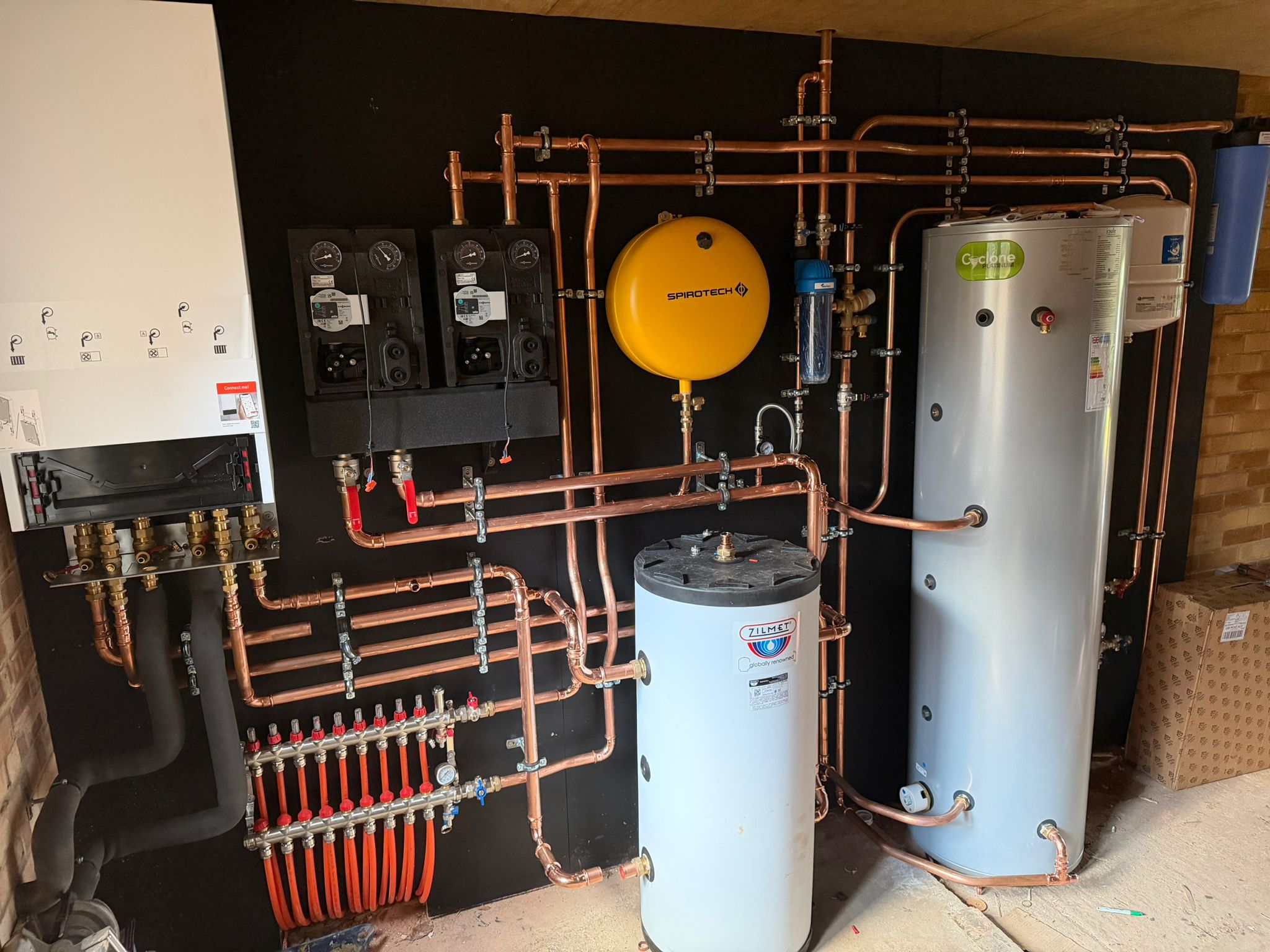
Because of the dual temperature requirement, we installed two Viessmann Divicon mixing circuits via a distribution header and buffer. While I would normally avoid hydraulic separation, in this retrofit scenario it provided predictable blending and stable hydraulic control between zones.
My customer was already clued up on heat pumps and their benefits so when we discussed the project, they were already keen to go ahead with the system and the conversation was more around the outcomes and how to ensure the best efficiency and performance. Following the initial investigation of the house and the requirements of the family, I had identified that a heat pump and underfloor heating would be the best solution to ensure all over comfort and the efficiency needed. I chose to locate the heat pump at the side of the buildings so that it could be tucked away and not impact the aesthetics of the house, but also because of the close proximity to the plant room.
System water volume was initially marginal for a 13kW unit, so additional thermal mass was introduced to prevent short cycling and protect compressor longevity. This significantly improved operational stability.
The system water volume was initially marginal for a 13kW unit, so additional thermal mass was introduced to prevent short cycling and protect compressor longevity. This significantly improved the overall operational stability of the system.
The routed chipboard underfloor heating presented further challenges in terms of pipe layout flexibility and heat output control. Unlike traditional systems, routed chipboard limits how pipework can be installed, which can make it more difficult to achieve the required heat output consistently. In addition, timber is a poor conductor of heat, so there were concerns around maintaining system performance, as well as the potential for expansion and contraction causing noise or movement within the floor. To address this, a chipboard with a 100 micron foil layer was used, rather than the standard 50 micron, to improve heat transfer. D3 and expanding glue were also applied to help minimise movement and prevent the floor from becoming creaky over time.
Through careful circuit design, precise balancing, and detailed commissioning, the system was able to operate efficiently at 45°C while maintaining comfort levels throughout the property.
The final outcome was a stable and efficient retrofit, delivering consistent comfort across what was a traditionally difficult property type. The property had been extended over time using different construction methods, including a conservatory-style structure at the rear with a timber frame and poor glazing. This created varying heat loss characteristics throughout the building, making it more challenging to design a system that could deliver even heat distribution.
To address this, a full heat loss calculation was carried out, taking into account the different building elements and areas of higher heat loss. From this, the pipework and system design were calculated to ensure consistent heat output across all areas of the property.
Further investigation work was also undertaken, including opening up sections to understand the existing construction, such as ceilings and walls. The property already had cavity wall insulation installed, and pitched roof areas at the front were assessed, with recommendations made to install additional insulation there to improve overall building performance.
Given the property was not initially “heat pump ready,” steps were taken to improve its suitability. A Zehnder MVHR system was installed, which helped reduce overall heat loss and improve efficiency by recovering heat within the home.
Overall, the main challenges were the mixed construction types, varying insulation levels, and higher heat loss areas. These were addressed through detailed assessment, system design, and targeted improvements to the building fabric, demonstrating that even older and more complex properties can achieve low-temperature, high-performance heating when properly engineered.
Which products did you select for the job and why?
We carried out a full independent room-by-room heat loss assessment, confirming a peak demand of 10.69kW for the 1960s property. During surveying, we identified insulation gaps and recommended fabric improvements before final design, ensuring the heat pump was specified around optimised performance rather than existing inefficiencies.
We installed a Viessmann Vitocal 13kW heat pump, selected for its wide modulation range and strong performance at low flow temperatures. The property required 35°C on the ground floor and 45°C on the first floor, so stable operation across dual temperature demands was essential. Weather compensation was configured during commissioning to enable true load matching and minimise compressor cycling. The heat loss calculation informed the size of heat pump required.
The system was commissioned to operate at a 5K ΔT, delivering stable flow rates and consistently low return temperatures to protect seasonal efficiency. Run times were optimised for long, steady cycles rather than short bursts, improving overall performance and longevity.
Domestic hot water is provided via a 300L Joule cylinder, chosen for its large surface area coil and excellent heat pump compatibility. This allowed effective recovery without increasing primary flow temperatures, maintaining strong COP during DHW production.
To manage the two temperature zones, two Viessmann Divicon mixing circuits were installed via a distribution header. While I generally avoid hydraulic separation, in this case it ensured accurate blending, predictable flow control and stable commissioning results. A 100L buffer vessel was added to increase system volume and prevent short cycling on the 13kW unit.
Post-commissioning monitoring confirmed longer run durations and smoother modulation, indicating stable and efficient system performance. The underfloor heating system was designed and supplied with support from Theoheat, who assisted with system design rather than providing a generic pipe centre layout. Their approach ensured the system was properly sized to meet the property’s specific requirements.
Theoheat manifolds were installed alongside PERT EVOH pipework, providing oxygen protection and reliable thermal performance. The circuits were balanced in line with calculated W/m² heat loss figures rather than standard pipe centres, enabling the system to operate efficiently at 30°C.
Domestic hot water circulation is provided by a Wilo Smart secondary return pump, controlled via PIR sensors located in the furthest bathrooms. This setup reduces unnecessary operation, helping to minimise parasitic energy use and secondary heat losses. Wilo pumps were selected due to their reliability and low electrical consumption, contributing to overall system efficiency.
A Spirotech 25L expansion vessel was installed to accommodate the larger system water volume. This is necessary to manage expansion within the system and maintain stable operating pressure. The brand was chosen for its build quality and reliability, particularly important given the volume of water within the system.
Water quality protection was implemented in line with VDI 2035 principles. This included the use of Elexion conditioning and an Aquabion system for scale reduction. These products were selected to maintain system water quality, reduce the risk of scale build-up, and protect system components over time.
The system is controlled using Viessmann weather compensation controls, which adjust flow temperatures based on external conditions. This is the most effective way to operate a heat pump efficiently, and the customer has been satisfied with how the system performs in practice.
Tell us what was different or unique/challenging
This project stood out from the outset. The client, Vladamire, is highly knowledgeable and had completed his own heat loss and MVHR designs before approaching installers. He chose us because we were confident enough to challenge and refine his calculations rather than simply agree with them, setting the tone for a true engineering collaboration.
Two key constraints defined the challenge: large conservatory-style timber structures with poor glazing that could not be replaced, and a requirement for underfloor heating upstairs with zero increase in finished floor height.
On the ground floor, insulation options were limited. We could not install Celotex or create an insulated build-up due to thresholds and levels, so we specified high-performance SuperFOIL directly over the concrete slab. Pipework was individually nail-clipped into the concrete to maintain spacing and output. Although labour intensive, this retained floor heights while achieving the required performance. The UFH was designed precisely to watts per m², adjusting pipe centres room by room and achieving a 30°C design flow temperature with weather compensation.
Upstairs, existing chipboard was removed and replaced with pre-routed boards incorporating high 100-micron conductive foil overlay, resulting in a 45°C design temperature.
To manage the dual temperatures, we introduced mixing stations and added a 100-litre buffer to a 13kW system with only 244 litres of volume, improving stability and reducing cycling. Every circuit was calculated, balanced and commissioned accurately. This project reflects confident, constraint-led engineering delivering efficient performance.
Tell us what you learned and what you may do differently/apply to a job in future
This project reinforced the importance of system volume and hydraulic stability when working with higher output heat pumps in properties with mixed temperature requirements. Early design decisions around water content and emitter sizing directly influence compressor longevity and seasonal efficiency.
One of the biggest lessons came from installing routed chipboard underfloor heating. While it can be an effective low-profile solution, in practice it proved extremely labour intensive and restrictive from both a pipe layout and heat output perspective. Achieving consistent circuit spacing and maintaining design outputs required significantly more time and precision than conventional screeded systems.
Going forward, I would be far more selective about where this type of system is specified. Where possible, I would influence design earlier to favour solutions that allow greater flexibility in pipe spacing, improved heat transfer and more efficient installation timeframes. Not all systems that look good on paper translate well on site, and this experience reinforced the importance of practicality alongside theory.
The project also highlighted the value of detailed commissioning. Fine-tuning weather compensation curves and balancing circuits to calculated W/m² rather than assumptions made a measurable difference to return temperatures and overall performance. In future installations, I will continue to prioritise commissioning time, as this is where true efficiency is secured.
Overall, this job reinforced that high-performance heat pump systems are engineered, not assembled and continuous learning on real projects is what drives better outcomes for the next one.
Customer testimonial:
We appointed Eco Renewables Ltd to design and install an air source heat pump system and MVHR as part of a comprehensive renovation of our home in [town] Maidenhead. From the very first engagement, Adam stood out from a number of other highly regarded installers through the depth, rigour and integrity of his approach.
We commissioned five independent heat loss surveys during the early stages of the project. Adam [name] was one of the few engineers to undertake a fully measured, area-by-area assessment, and crucially, the only one to challenge aspects of the brief and recommend targeted improvements to the building fabric. These were practical, evidence-based suggestions that materially improved the overall system design, rather than simply optimising around existing constraints.
The design process felt collaborative and technically robust. Adam [name] demonstrated a clear understanding of both conventional and more advanced system strategies, and was willing to explore exotic approaches — particularly in more complex areas such as the upstairs heating solution — while maintaining a clear, structured explanation of the associated trade-offs. As the specification evolved, he communicated transparently on performance implications, cost deltas and system complexity, allowing us to make informed decisions without pressure.
The installation phase further reinforced this level of quality. Adam [name] remained directly involved throughout and took full ownership of delivery, rather than delegating heavily to third parties. The result was a consistent standard of workmanship, with particular attention paid to system layout, pipe routing and integration within the constraints of an active renovation site. Several elements of the installation were clearly more labour-intensive than typical, but there was no sense of compromise in execution.
The system has now been commissioned and is performing well, providing a stable and comfortable internal environment even at this interim stage of the renovation.
Overall, what sets Eco Renewables Ltd apart is a combination of technical rigour, intellectual honesty and a clear commitment to doing things properly rather than conveniently. Adam [name’s] willingness to challenge assumptions, engage deeply with the design, and personally deliver the installation to a high standard makes him a top professional in the field.
(homeowner)

Qualifications
Extra training and/or CPD you’ve done in the past 12 months
Over the past year I’ve made a big effort to focus on CPD that genuinely improves my engineering work. I attended several trade shows and deliberately avoided the sales pitch side of things — instead I spent most of my time talking to the technical teams and the engineers who actually design the products. Those conversations gave me real insight into how different boilers, pumps, valves and controls behave in difficult conditions, which directly influences how I design systems for older buildings.
I also visited two manufacturing facilities this year. Seeing how components are assembled, tested and stress-checked was a huge eye-opener. It helped me understand the small details that make one product reliable and another one problematic, especially on remote jobs where reliability really matters.
A lot of my CPD this year has been self-driven too. I’ve been documenting more of my work, analysing system performance, learning from real installations, and sharing those lessons in a few industry podcasts. I was also asked to contribute to a new heat pump book written by over 30 engineers. My section is about ECO-scheme installs and the red flags homeowners should watch for — something I feel strongly about because poor ECO4 work is damaging trust in our trade.
On the regulatory side, I completed my Gas ACS 5-year reassessment and passed both my annual Gas Safe and OFTEC inspections, keeping all my qualifications current and compliant.
Please tell us about one or more projects you are particularly proud of
One project I’m particularly proud of is a full heating system I engineered for a 198m², 200-year-old stone farmhouse that had stood abandoned for nearly a century. Untouched by modern services, the building had no internal power or infrastructure and had only ever served as basic shelter for a shepherd tending his flock. Fully exposed on a ridge, it endures harsher weather than most locations in the area.
The biggest challenge was how the building behaved thermally. The 700 mm thick stone walls retained moisture and introduced enormous thermal mass, meaning the structure responded very slowly to changes in temperature. Combined with extreme wind exposure on the ridge, this resulted in rapid fluctuations in heat loss that a conventional high-temperature, on/off oil system would have been completely unable to manage. Such a system would have overshot, short-cycled, and delivered poor comfort levels.
My aim was to design a heating system capable of delivering the full 24 kW heat load required at an external temperature of –1.5 °C, while operating at the lowest possible flow temperatures. As the heat demand reduced with rising external temperatures, the system needed to adapt accordingly, allowing the boiler to remain in condensing mode for the majority of its runtime, maximising both efficiency and long-term stability.
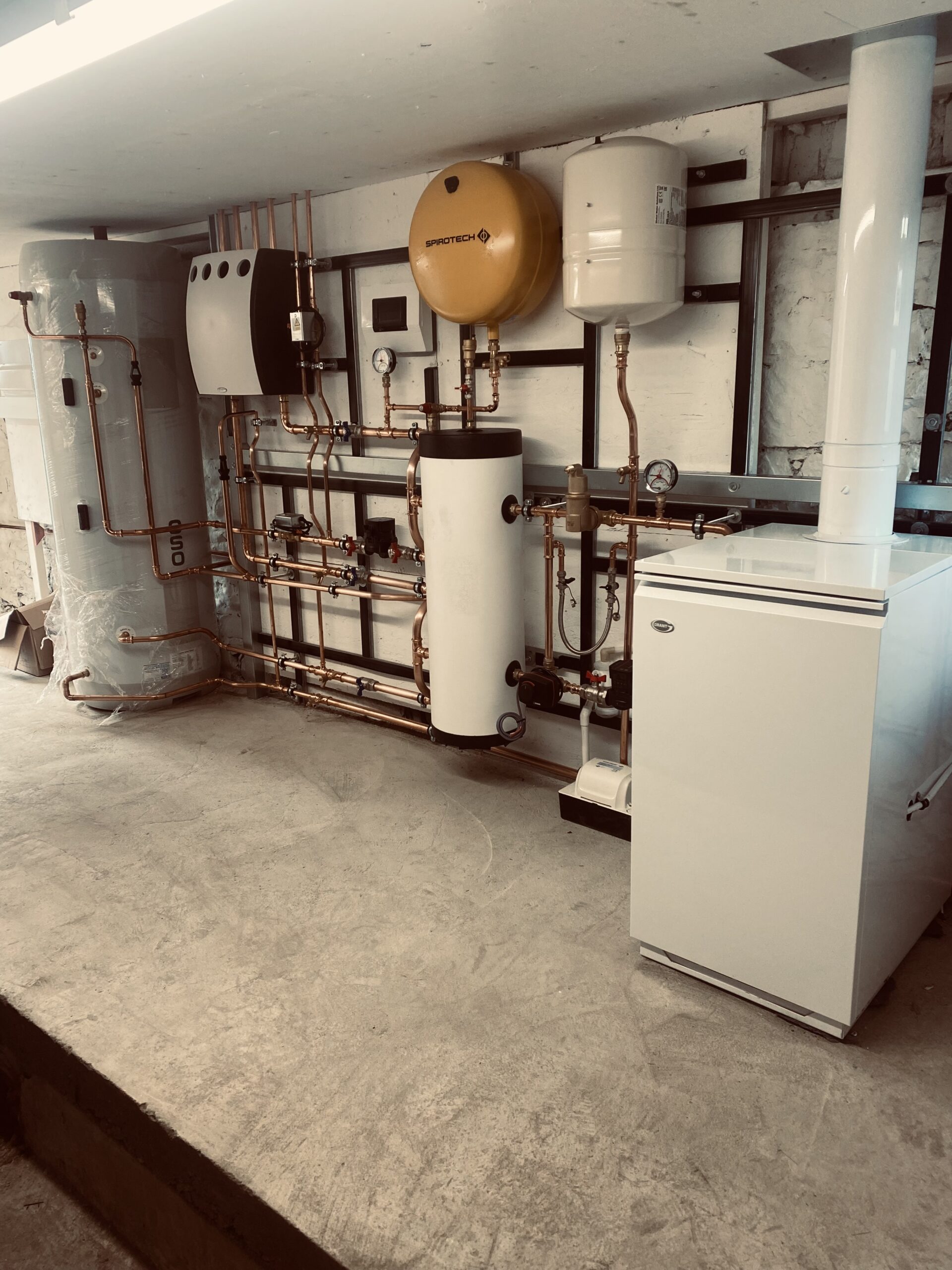
I carried out a detailed room-by-room heat-loss calculation, adjusting for exposure, elevation and the way saturated stone affects performance. The modelling ruled out a heat pump — the building needs 50°C+ flow temperatures in storms, and the remote electrical supply wouldn’t support a heat pump setup anyway. I built the system around a Grant condensing boiler, a buffer tank and proper weather-compensated mixing, giving long, steady burn times at low temperatures with enough headroom for rough weather.
My customer for this project was an agricultural engineer so the decision-making was a collaborative process, but he did have several conditions that he wanted to be met, which was a good opportunity for me to work within a customer’s requests but also make the project as efficient as possible. My conversations with the customer were helpful too because we each shared our opinions and helped the other understand where those opinions came from and whether they needed updating. This was a significant project for the homeowner and had the potential to be an incredibly special home, so finding the best possible outcome for the heating installation was crucial for future comfort and longevity.
The customer also wanted no visible pipework. This meant every heating run had to be chased into the 700 mm stone walls, cut carefully to avoid weakening the structure, and rendered over to match the building’s original finish.
A specialist company installed the spring-fed water system, including tanks and filtration. From there, I designed and installed all internal cold-water distribution through the house, planning routes and pipe sizes to ensure minimum pressure loss and quiet, reliable operation.
Which products did you select for the job and why?
The project was delivered to a quality-led budget, where the emphasis was placed on performance, reliability, and long-term durability rather than minimising initial cost.
For this job I chose equipment that prioritised reliability, serviceability and suitability for an older building with no existing heating system. From a performance standpoint, the Grant Vortex condensing boiler was selected for its high water-content steel heat exchanger, which provides inherent thermal stability and helps reduce short-cycling in a high thermal-mass property. With correct return-temperature control, it operates efficiently in sustained condensing mode.
In terms of fit and value, the boiler is well proven in rural, exposed locations, tolerant of variable flow conditions, and straightforward to maintain with readily available parts. It is also fully HVO-ready, providing long-term flexibility and futureproofing of the installation.
A Zilmet buffer vessel was added to prevent short cycling and keep burner cycles long and efficient. For hot water, I used an OSO unvented cylinder because the insulation is excellent, and their internal construction handles treated spring water well.
To protect the boiler, I fitted ESBE mixing valves set to hold the return temperature above 45°C. If the return gets too cold, condensate forms in the steel water jacket and causes corrosion. Holding the return temperature above 45°C prevents this and keeps the boiler running correctly. MeiFlow pump groups were chosen for their compact, insulated design and ease of service. They also include ESBE valves for proper weather compensation, allowing the flow temperature to follow outdoor conditions for smoother operation.
I installed Spirovent deaerators because heating water always contains microbubbles. If they aren’t removed they gather in high points, restrict circulation and introduce oxygen, which shortens the life of pumps, valves and the boiler. Spirovent clears microbubbles continuously.
All 13 radiators were run individually from an IVAR manifold in 20 mm pre-insulated PERT-AL-PERT MLCP pipe. This gave every radiator its own circuit, made balancing simple and keeps heat delivery very consistent. Actuators on bedroom thermostats act as high-limit protection to prevent overheating.
The job started with a full Heat Engineer model. All heating pipework was chased into the 700 mm stone walls.
Tell us what was different or unique/challenging
What really made this job stand out was the chance to build the first proper heating system the house had ever had in its 200-year life. There was no old layout to copy and nothing to upgrade — it was a completely blank building. It had been unused as a home for around 100 years, so every decision had to come from first principles.
One of the most unique parts of the job was turning a standard oil boiler into a system that behaves like a modern, weather-compensated setup. Oil boilers are usually simple on/off units running at fixed high temperatures. On this project, the boiler became part of a proper controlled system: the buffer, ESBE valves, outdoor sensor and Envigor controls all work together so the flow temperature changes with the weather, and the return stays above 45°C to protect the steel heat exchanger. It’s not something you normally see with oil heating, and it worked exactly as I had planned.
I selected a standard oil boiler for two reasons. One, because I knew I could engineer it into a more efficient system and still meet the requirements that my customer had set out. Two, because I wanted to ensure that my customer could get servicing support and parts for the system going forwards easily – for example if I was unavailable and another engineer needed to attend. Selecting a standard oil boiler and modifying afterwards made this possible.
The heating distribution also made this job stand out. All 15 radiators were given their own circuits back to an IVAR manifold, which meant I could balance everything properly and keep heat delivery consistent across the whole house. It’s more work than a standard two-pipe system, but the result is far better e.g. consistent energy distribution, constant pipework pre insulated for reduced pressure loss, ease of maintenance.
The most satisfying part was seeing the whole system running smoothly in a building that had never had heating before. The house now warms evenly, runs quietly and holds temperature well, and all the mechanical work is hidden so the character of the building hasn’t changed. It’s a proper engineered system in a very old property, and that’s what makes the job memorable.
Tell us what you learned and what you may do differently/apply to a job in future
This job reinforced just how critical the design stage is, particularly when there is no existing system to reference. With a total calculated heat loss of 24 kW at design conditions — and individual spaces such as the main lounge accounting for up to 5.5 kW — every decision depended on the accuracy of the heat-loss work and getting the layout right from the outset. The lounge itself was a long space containing the majority of the ground-floor floor area, so rather than relying on a single oversized radiator at one end, I deliberately spread multiple radiators along its length to achieve even heat distribution and consistent comfort throughout the room. It reinforced the value of slowing down, planning thoroughly, and thinking several steps ahead, an approach I will continue to apply and refine on every future project.
A big takeaway was how well a standard oil boiler can perform when you give it proper control. Setting it up with weather compensation, a buffer and return protection showed me that oil systems can be much more stable than most people expect. It’s made me even more committed to using smarter control strategies in future installs, not just on complex ones.
I normally use manifold distribution anyway, but this project confirmed why it’s worth doing. Having every radiator on its own circuit makes balancing easier and gives a much more predictable system long-term. It’s more work at the start, but the performance speaks for itself.
Working in a building this old also reinforced how important it is to respect the fabric of the house. Every decision had to be made with the building’s age in mind. It reminded me that sometimes the considered, more careful approach produces the best results.
If I were to change anything next time, it would be getting the Envigor control strategy involved even earlier in the design. The level of detail it gives during commissioning and the ability to fine-tune the system afterwards is something I want to build into more projects from day one.
Overall, this job strengthened the way I already work: proper design, proper control, and systems built around the building itself, not a generic template. This ensured satisfaction for myself as the heating engineer but also for my customer, who put so much trust in me.

Qualifications
Extra training and/or CPD you’ve done in the past 12 months
Please tell us about one or more projects you are particularly proud of
On this project, I was contacted by the client who we had been recommended to, she wanted an Air Source heat pump installed to replace her current open vented gas fired heating system, a job that had been rejected by other companies as being non suitable for a heat pump due to microbore pipework, or too difficult.
Upon visiting I carried out Full heat loss calculations to understand the homes thermal performance; with this data I found the system had a heat loss of 10.36KW at -3oC Design outside Temperature.
Using this information, I designed the heating system, using the CIBSE heat & design guide to meet the proper regulations. I knew there was existing microbore pipework to contend with coming from two central manifolds under the floor upstairs, and one in the shoe cupboard downstairs, as I had lifted a pre-cut section of flooring on the landing whilst on heat loss survey to inspect.
I knew this may become an obstacle due to the run lengths of microbore, and the energy that they were responsible to deliver to each room, and therefore the system may have required hydraulic separation, as floors were chipboard, it would not have been feasible to lift them to replace pipework sections.
Whilst designing the system I worked out my index circuit, and calculated that with all other components included, that the circulation pump within the heat pump would have enough head remaining to overcome the circuit with the highest resistance.
this gave me confidence that hydraulic separation would not be needed and a more efficient, open looped system would be achievable.
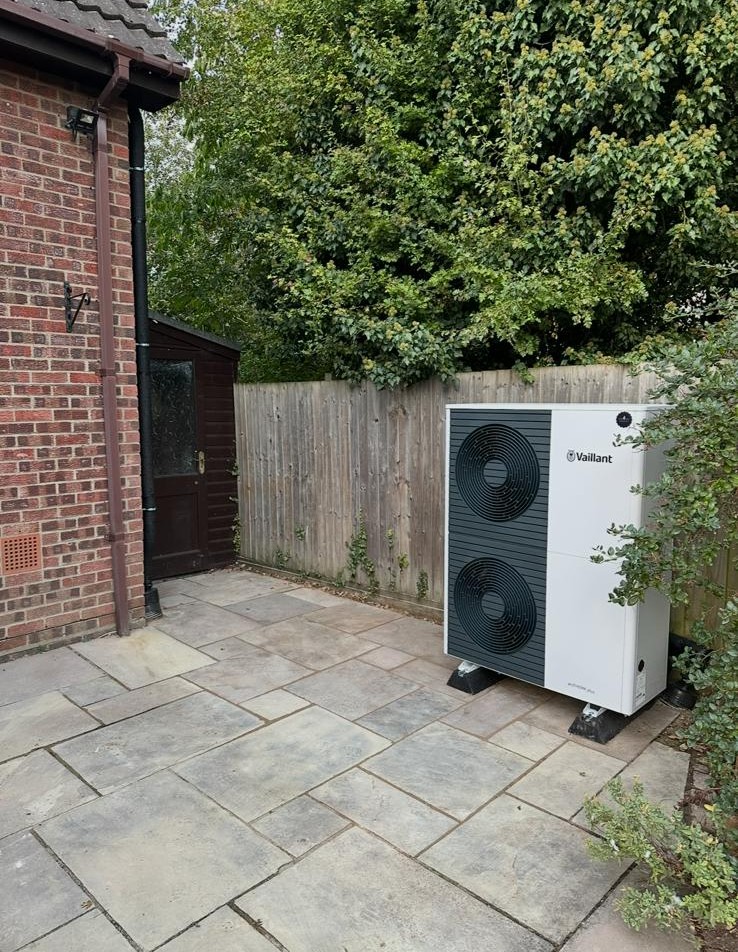
Our second Obstacle was location of the heat pump, the property was large, 4 Bed, 2 Bath 224m Squared, but had nowhere feasible against the house for a heat pump to be located, and the patio been Indian sandstone made it difficult to locate the heat pump away from the property, and because of the size of the heat pump, a bracket would not of been an option, also resonance through the brickwork is always a concern.
I decided the best option would be to locate the heat pump at the opposite side of the patio, this involved carefully lifting the sandstone patio, and digging a deep trench by hand, to avoid damage, from the heat pump position to the side of the house to bury the pre insulated pipe below frost line and bring it back up where the pipework would be non-intrusive. Whilst this was up I also reinforced under the Heat pump, refilled and re-laid the patio.
We replaced all the radiators in the house, because we were designing to a lower flow temp, we used manufacturers radiators conversation factors to design the whole system correctly.
We can confirm looking at our Myvaillant Pro Serice Installer app, where we track running data from all our systems, that the unit has had a total combined COP of 4.5 for January, 5.1 for December, 5.1 for November, 5.5 for October. Also, the homeowner’s app shows that he’s saved 35% on his energy bill from last Feb with the old kit and this Feb with the new heating system in place. This includes an extra area he’s now heating too – last year they only heated the main house but this year they are also heating an annex, so actually the like for like savings are a lot more.
Which products did you select for the job and why?
I calculated the correct pipe size to carry our load aiming for around 0.9 m/s velocity to the airing cupboard with minimal pressure loss, for the pre-insulated underground pipe, I specked the pipe size to match the internal diameter of the copper pipe we were using for the remaining primary run.
On the Outside of the house, we used Mitred primary pro 19mm insulation with Bond and seal because this creates great protection against heat loss and the elements and prevents water ingress, I used Walraven speed rail brackets to secure.
The Heat Pump I chose was Vaillant Arotherm plus because of its one of the best all round performing heat pumps with some of the best weather compensated controls on the market with some of the best anticyclone software of any control, easy to use APP for the client, and quiet.
I paired this with the Vaillant Unistore Pure 300L cylinder due to its large coil surface area size for quick recovery and maximum heat transfer to meet the clients high hot water demands.
I Installed a Fill and Flush with built in Magnetic strainer from second renewables to ensure the system could be treated, and protected adequately.
I also used butterfly valves under each auto air vent so that in the event of them weeping, they could be replaced without the system being drained, I also installed Tesla expansion isolation valves for this same purpose.
Hot water cylinder Inlet valve and expansion vessel were placed above the cylinder, so that again, they could be serviced without having to drain the hot water cylinder.
I also installed a Volumiser on this system on the return to increase intrinsic system volume to reduce cycling and aid defrost cycles, to help reduce heat being drawn out from the home whilst defrosting.
I Used 160mm Pre insulated pipe from Flo supplies and twin walled ducting for the cable run underground to the heat pump, all sides were fitted with Shrink caps to prevent water ingress.
To insulate the primary runs in the loft, I used 19mm rubaflex with taped joints to minimise heat loss.
This system water was conditioned to VDI2035 parameters, treating the water with a resin bed to remove impurities in the water, reducing galvanic corrosion and scale formation. I also installed an elexion top up unit, so if the client needed to top up the system, they wouldn’t be introducing untreated water into the system.
All Emitters were replaced and some repurposed in other rooms to reduce capital costs, to achieve a flow temperature of 45oC.
Tell us what was different or unique/challenging
The most satisfying parts of this job were running the system after install, and checking flow rates to see that I could achieve my required mass flow rate at 80% pump speed, so I knew that my calculations were correct.
Also, the aesthetic finish of the job, no one would have known that the patio had been upheaved to install the heat pump in its final place, it looked neat and aesthetically pleasing.
And finally the client’s delight with the running performance of the Heat pump.
The client stated when asked how she was finding it after a heating season “We Love it! House is lovely and warm and cosy all the time. Loving the additional hot water capacity in the tank! Might be too early to judge COP but were finding energy costs noticeably down, even before solar panels and battery installed in January!”
Tell us what you learned and what you may do differently/apply to a job in future
I learned to trust the maths, trust your calculations, if they are thoroughly calculated and you have dotted every I and crossed every T, then you will be alright. Just because a system is microbore, and others state that it can’t be done, to carry out your own investigations; come up with your own views and show the evidence, trust your own calculations, rather than relying on others’ opinions on what will work, and what will not work.
Also, I learned that digging a long deep trench in the rain is very hard work, and maybe use a labourer next time!

Qualifications
Extra training and/or CPD you’ve done in the past 12 months
Please tell us about one or more projects you are particularly proud of
One project I am particularly proud of was the design and installation of an air source heat pump system for two large “eco” houses on a single development plot. Both properties were built to a high standard of insulation, including approximately 150mm of floor insulation (Celotex) and 150mm in the loft, which made them well suited to low-temperature heating design.
The larger property (Plot 2) was around 4,000 sq ft and included an annex, four bedrooms (three with en-suites), and a family bathroom. The second property (Plot 1) was slightly smaller but followed a similar layout, also with four bedrooms, three en-suites, and a family bathroom.
I was given a high degree of autonomy to specify the system design. Initially, I recommended an open-loop approach to simplify the system and maximise efficiency. However, the developer requested that each property have separate heating control between upstairs and downstairs. Taking this into account, I designed a system that met their requirements while still maintaining strong performance and cost efficiency.
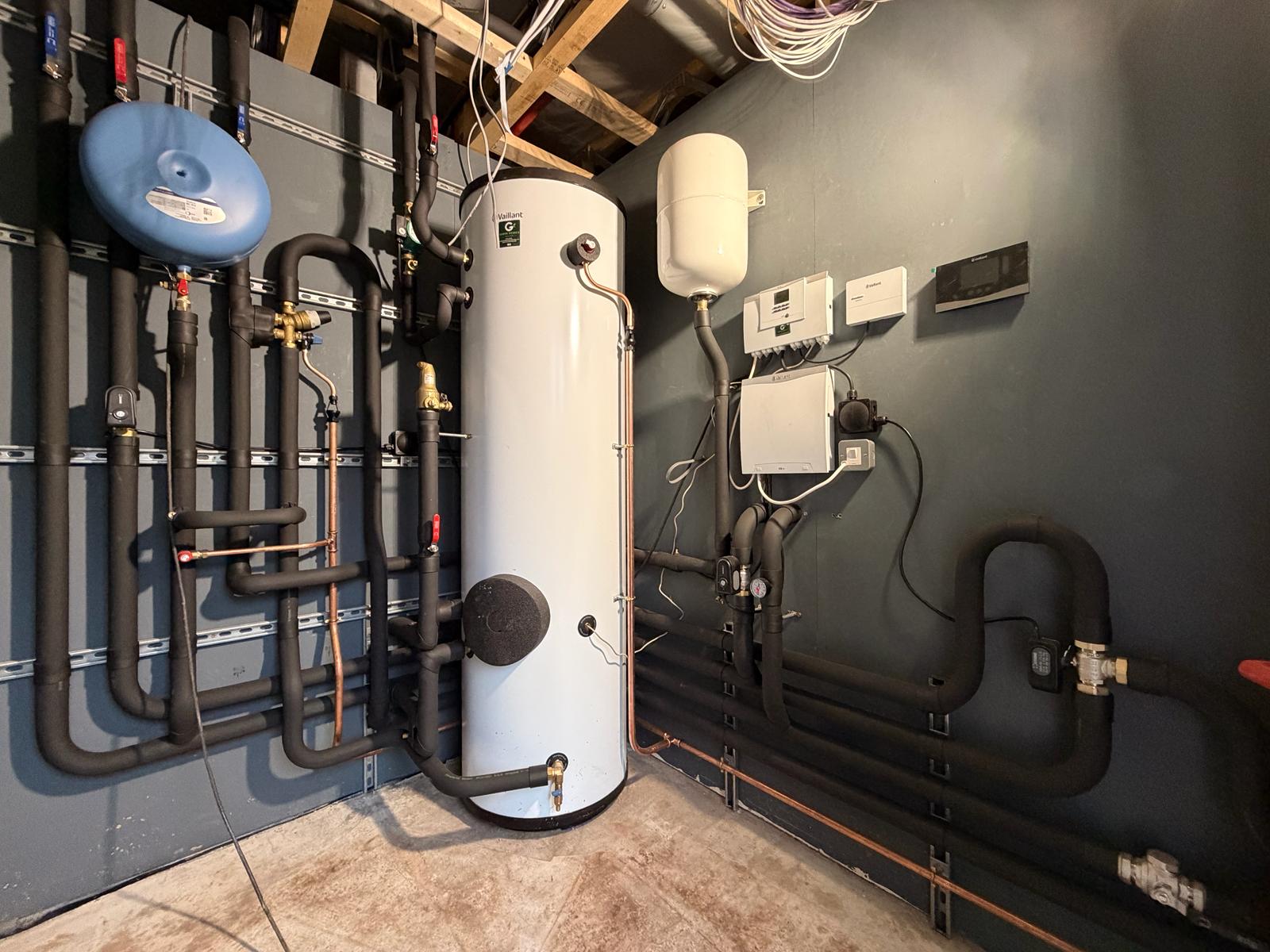
Underfloor heating was specified throughout both floors of each property, designed with a flow temperature of 40°C at -3°C external conditions. To maintain high system efficiency, I opted for a bufferless design and used ESBE MBA zone valves to divide the system into upstairs and downstairs zones. These were wired back to a VR71 control module and operated via two VR92 controllers, allowing independent control of each zone.
Although the system was physically split to meet the developer’s requirements, the chosen control strategy (Vaillant) also allows the end user to operate the system as a single zone if preferred, providing flexibility without compromising the original brief.
This project stands out to me because I was responsible for the full system specification and had to balance efficiency, cost, and client expectations. It demonstrates my ability to design practical, high-performing heating systems while adapting to client needs and constraints.
Which products did you select for the job and why?
For this project, I specified the Vaillant Arotherm Plus 10kw due to the relatively lower cost compared to my preferred manufacturer without sacrificing too much performance or build quality.
I used the new ESBE MBA 132 and 122 1 1/4’’ 2 and 3 port valves due to their high KV values (11.3 and 60kvs respectively), as well as using pulled bends to reduce resistance.
For system protection and hydraulic stability, I used IMI Hydronic Engineering vessels and air separation equipment. These were chosen for their higher build quality and proven performance compared to more budget-oriented alternatives, helping to ensure long-term reliability and effective air removal within the system.
In addition, I specified a full primary pro kit on the heat pump, including antifreeze valves (erring on the side of caution given the system design), as well as the manufacturer’s interconnection and primary pipework kit mounted directly to the rear of the unit. This created a clean, well-integrated installation and simplified commissioning.
For the underfloor heating, I used unbranded manifolds sourced through local merchants. This was a deliberate cost-saving decision, as the manifolds still met the required performance criteria without adding unnecessary expense to the project.
Overall, my product selection focused on achieving a high-performing, efficient system while carefully managing installation costs and maintaining reliability.
Tell us what was different or unique/challenging
One of the more unique and challenging aspects of this project was my decision to use exclusively 28mm and 35mm pulled bends throughout the heating circuit within the plant room. This was a challenge I set myself during the design stage, with the aim of minimising flow resistance and improving overall system efficiency by avoiding unnecessary fittings.
In practice, this proved to be quite demanding. Larger diameter pulled bends, particularly in 28mm and 35mm, require significant space once formed, which added complexity to both the layout and installation. The plant room itself was relatively compact at approximately 2.4m by 1.8m, so careful planning was essential to ensure everything could be installed cleanly without compromising accessibility or serviceability.
To manage this, I fully boarded out the plant room and took a very methodical approach to the pipework design. I also pre-fabricated and trialled sections of the layout at home, to ensure everything would fit and function as intended before final installation.
Tell us what you learned and what you may do differently/apply to a job in future
One of the key things I learned from this project was the importance of planning not just for the immediate installation, but for future upgrades and overall finish.
I will be returning to this job to further improve the installation by adding galvanised containment for the electrical wiring. While the system is fully functional, this will bring the wiring aesthetics up to the same standard as the rest of the plant room, creating a more complete and professional finish.
In addition, I designed the system with future adaptability in mind. The developer wanted to offer buyers the option of passive cooling, so I ensured that all pipework was vapour sealed and suitable for cooling operation from the outset. When I return, I will be installing the necessary cooling interface (chip) in the external unit to enable this function via the underfloor heating system.
This experience reinforced the value of forward planning and designing systems that can be easily upgraded without major rework. In future projects, I would aim to incorporate elements such as containment and optional features like cooling earlier in the installation phase where possible, while still maintaining flexibility for client choices.

Qualifications
Extra training and/or CPD you’ve done in the past 12 months
Please tell us about one or more projects you are particularly proud of
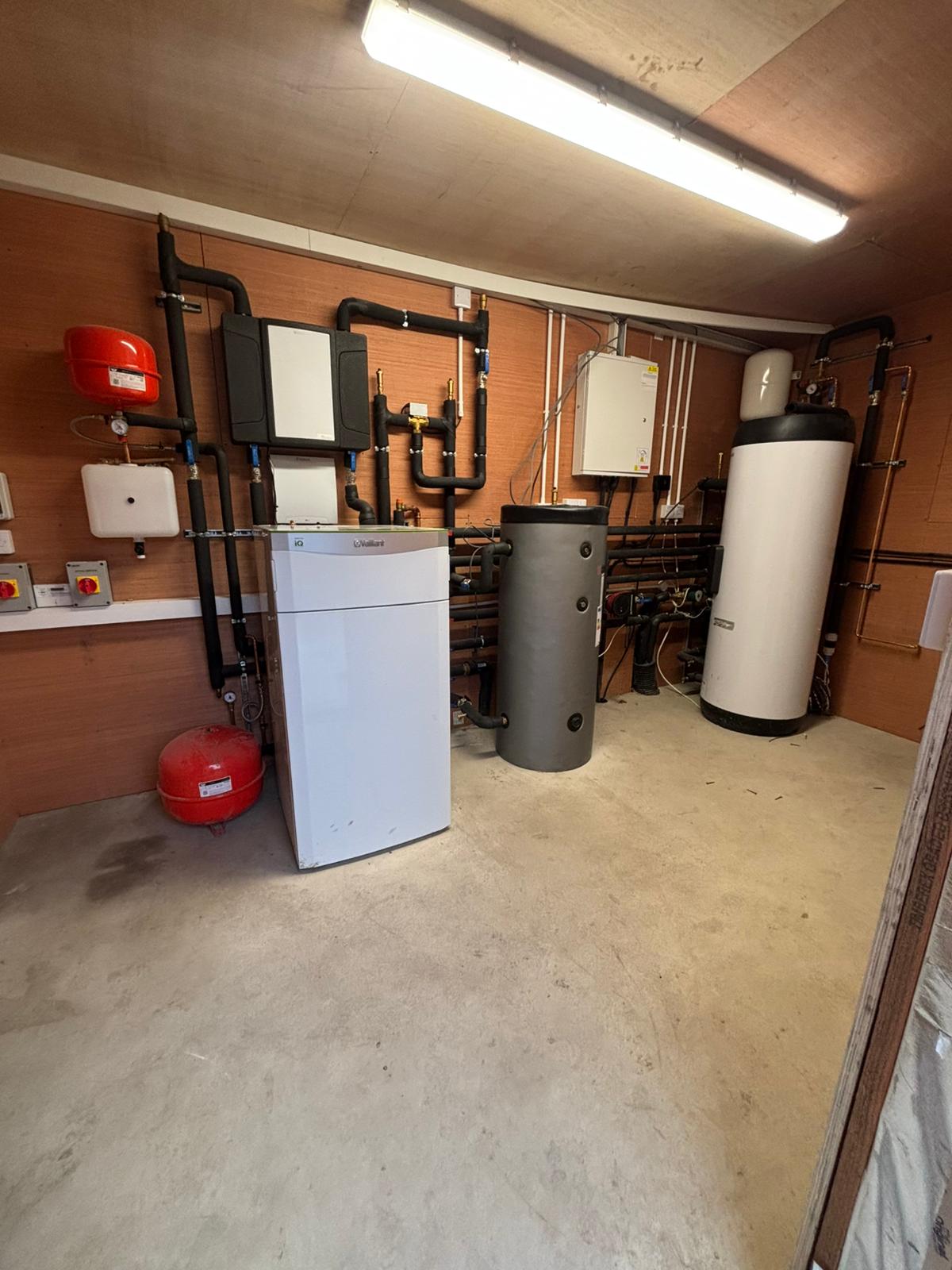
I was part of a team completing a full heating refurbishment, including installation of a ground source heat pump with ground loops around 35m from the house and full underfloor heating installation through all floors inside the house, along with all plumbing works. We also added a cooling module to ensure the customer can cool through the UFH during the summer period.
The customer was a family relocating from south to the Lakes. They were doing a full refurbishment of the house, which eventually included underfloor heating. They came to us through the builder with a request to install a heat pump on the 3 floor, 3 bed property, with 8 total rooms. The property was older, but it was a full restructure rebuild.
The customer wanted a ground source heat pump because they had one in their previous property. The heating demand was for 3 people. I advised and replaced all the heating with underfloor heating to increase efficiency for the property, and as it was a rebuild, we could advise on all the correct insulation to make it efficient. The property was different on different levels, so we had to make sure we had room for ground loops meaning we had to dig down deeper to make room for piping.
Which products did you select for the job and why?
I selected a Vaillant GSHP (Flexatherm) because it’s a reliable unit with a good back up service, with a warranty of up to 7 years when paired with its cylinder. We planned the job through Easy MCS to get the correct calculations (3.68 heatloss). We worked with the builder to install 3 x 200m ground loops and a header pipe around 50m to the plant room.
The underfloor heating was a staple system on the ground floor, and chipboard on the 2nd & 3rd floor, with groves. This meant there was less height restriction than if we added over-boards on top of the flooring.
We work with Cosy Floor to provide us with the MLCP pipework, and it is consistently good quality.
Our controls are Heatmizer, chosen for the compatibility with the system with a simple controller for customer ease.
The customer was fine with the budget and also had a BUS grant. We had good communication with them throughout.
Tell us what was different or unique/challenging
This job was particularly satisfying due to the different levels of land and space we had to work within. We had to make use of a bottom field for the ground loops and work up a level to get to the plant room. The house was built on stilts so we had to use the trench below for the header pipes.
The plant room itself took about 2 weeks, but the overall job was longer as we had to work around third parties such as builders. One our site follow up the customer expressed their thanks for the job and seemed very pleased.
Tell us what you learned and what you may do differently/apply to a job in future
One thing I would do differently about this job was improvement time management and organisation. There were a lot of visits due to things being ready at different times and this could have been improved with better planning and time management.
The job had added complexity because of the unanticipated work needed to be done. We initially quoted for a heat pump, but installed UFH too. In future we will be on site for constant weeks rather than intermittently (around builder schedules)

Qualifications
Extra training and/or CPD you’ve done in the past 12 months
We are always working on our CPD, doing heat pump manufacturer training courses with Viessmann, Stiebel Eltron, Nibe, Vaillant, Jaga.
Please tell us about one or more projects you are particularly proud of
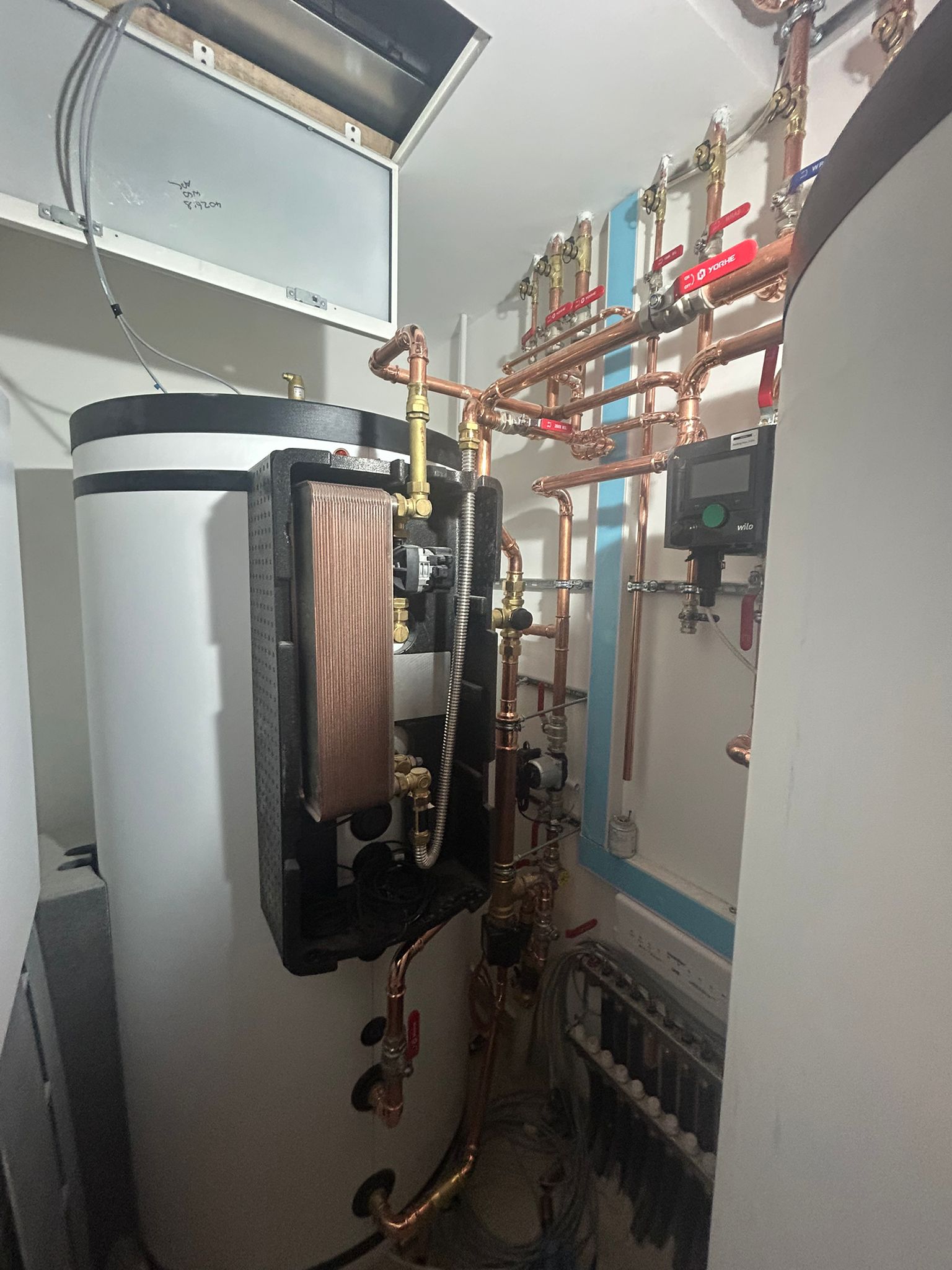
We were commissioned to design the heating and hot/cold water system for a large detached 350 square metre period property in central London. Home to a young couple, and with 5 bedrooms and 5 bathrooms, the property has higher got water demands then heating.
The property was being completely stripped, extended and refurbished, so there was scope for insulation upgrades and designing the system right from the ground up. The client wanted underfloor heating throughout and the ability to use all 5 shower/bathrooms at the same time during times when guests were visiting. They also wanted to be carbon neutral with no gas supply and running exclusively from a heat pump.
Our first steps was a full heat loss survey and design strategy. Initial estimates were a very high 30kw+ heat loss, but from getting the customer to agree to full internal wall insulation throughout and window upgrades, we were able to get this down to a reasonable heat loss of around 11kw at an outdoor design temperature of -2ºC. Insulation was an important fo this heat pump system, as with all the redbrick walls, it brought us into scope. We worked with the builders onsite to install the correct insulation.
Our next challenge was the hot water usage and recovery. This actually became more of an issue with heat pump selection than the heating. The client expected heavy hot water usage over holiday periods due to having a large family that would visit meaning high peak demand on services. Mains water would not be able to deliver such flow rates, so a boosted hot and cold-water system was designed.
Hot water storage and generation became the next problem to overcome. A small heat pump that would cover the heating load would give very long reheat times for hot water, which would not only require significant storage but would also mean the heating system would not be heated for such periods, meaning comfort would be sacrificed. So, we opted to fit a larger 18kw heat pump that would be matched for hot water generation for quicker recovery. We combined this with a 7.5kw inline heater that could boost the hot water generation during excessive peak usage if required.
Which products did you select for the job and why?
With the challenges presented, especially for hot water generation, fitting the right products was essential. We selected the Heliotherm range of heat pumps for their quality, output, features and product range. As three phase power was already available, we selected the 18kw three phase R290 heat pump to cover not only the heating needs but more power for hot water generation.
These larger heat pumps present their own challenge in that because of the large output and flow rates required, a normal indirect cylinder won’t have the coil size to transfer heat quick enough. Heliotherm offer a fresh hot water module, which is essentially a plate loading system that transfers heat from a buffer to fresh water throughput delivered to the hot water outlets. We selected a large 850 litre buffer for hot water generation and a 500 litre buffer for the heating system, to give good runtimes and efficiency for the heat pump.
For the underfloor heating system we selected the Variotherm overlay system for its high output and thermal mass. We matched the outputs carefully with the floor covering schedule to make sure that the right outputs could be delivered in each room and thanks to the insulation upgrades no supplementary heat via radiator was required. The UFH was zoned by floor, this was the customers choice as they wanted the system to join their smart home controls. This impacted the design as we had to account for and calculate flow rates for when zones were turned off, this meant we had to install a larger buffer.
For the hot/cold water system we selected a dual pump Dutypoint Scubatank booster pump and break tank combination product. This reduced our floor space requirements in the plant room whilst not sacrificing performance. The plant room was at the side of the house on the ground floor, measuring at 3x1m this made it more difficult to access, especially as other trades were also accessing it and needed space, such as the electrician with his MCHR unit we had to layer the system gradually to make it serviceable.
The Pipework was copper and MLCP because they are both reliable and sturdy products, and kept us within compliance too.
The controls were Heliotherm, the manufacturers own, set on weather Comp. We choose manufacturers own as they always work best with the pumps, which in turn makes it easier for the customer to use, requiring minimal input from them, and allows us to monitor.
Planning was done meticulously with careful coordination with the main building contractor and other trades. We used a mixture of our go too – Spruce, and H2X Software – because it’s a larger project – to help us plan the design. The software helped us spec pipe sizing and do drawings. A phased approach was required with the underfloor heating being installed over the three floors at different times as and when the floors were ready. A screed drying program was agreed with a temporary 9kw electric boiler used to keep the floors at a stable temperature and to dry out thoroughly for the finished floors to be fitted.
Budget was a consideration and the usual justification for a high-end install. The Customer qualified for the BUS grant, which we helped them secure.
Tell us what was different or unique/challenging
The unique challenge on this project was that unusually the hot water requirements dictated heat pump selection – typically it is the heating system requirements. Whilst we didn’t want to oversize the heat pump for heating, we did need to ensure hot water capability was fulfilled. Because the hotwater was an unusually high demand, we needed an extra boost on the demand. We chose an 18kw pump to manage, and paired it with a larger buffer, as larger pumps wont manage with just a regular cylinder because it won’t heat up quick enough. The heat pump was connected to two buffers, one for hot water and one for heating. There have been other challenges along the way as well, such as having to fight for plant room space with other trades as there was a lot of plant going in, we just communicated well and layered the plant to make it serviceable.
It stands out for us in that it was a large high end period project with a lot of variables to juggle, but we were able to overcome these issues and deliver a system that does everything it needs to and more ( I say more because, It hasn’t been installed for long and its already delivering above the projected efficiency), with the satisfaction that it is completely running of a renewables system.
Tell us what you learned and what you may do differently/apply to a job in future
It was a great opportunity to build on our experience and knowledge that renewable technology can work on any size or age of property. Even when traditional methods of hot water generation wouldn’t work, there are more ways to approach it with different solutions that can overcome such issues that may arise. This was our first install of this size, and we learnt a lot, especially to have confidence in our capabilities. The Heliotherm rep was really helpful, guiding us with selection and set up. Overall, our biggest learning was that we can make bigger properties work on heat pumps without going onto hybrid gas, and not incur too many problems.
What would I do differently? I think I’d fight harder to get a bigger plant room! And I need a team of Olympic weightlifters to help lift the heat pumps.
Qualifications
I have achieved the following all within the past 3 years:
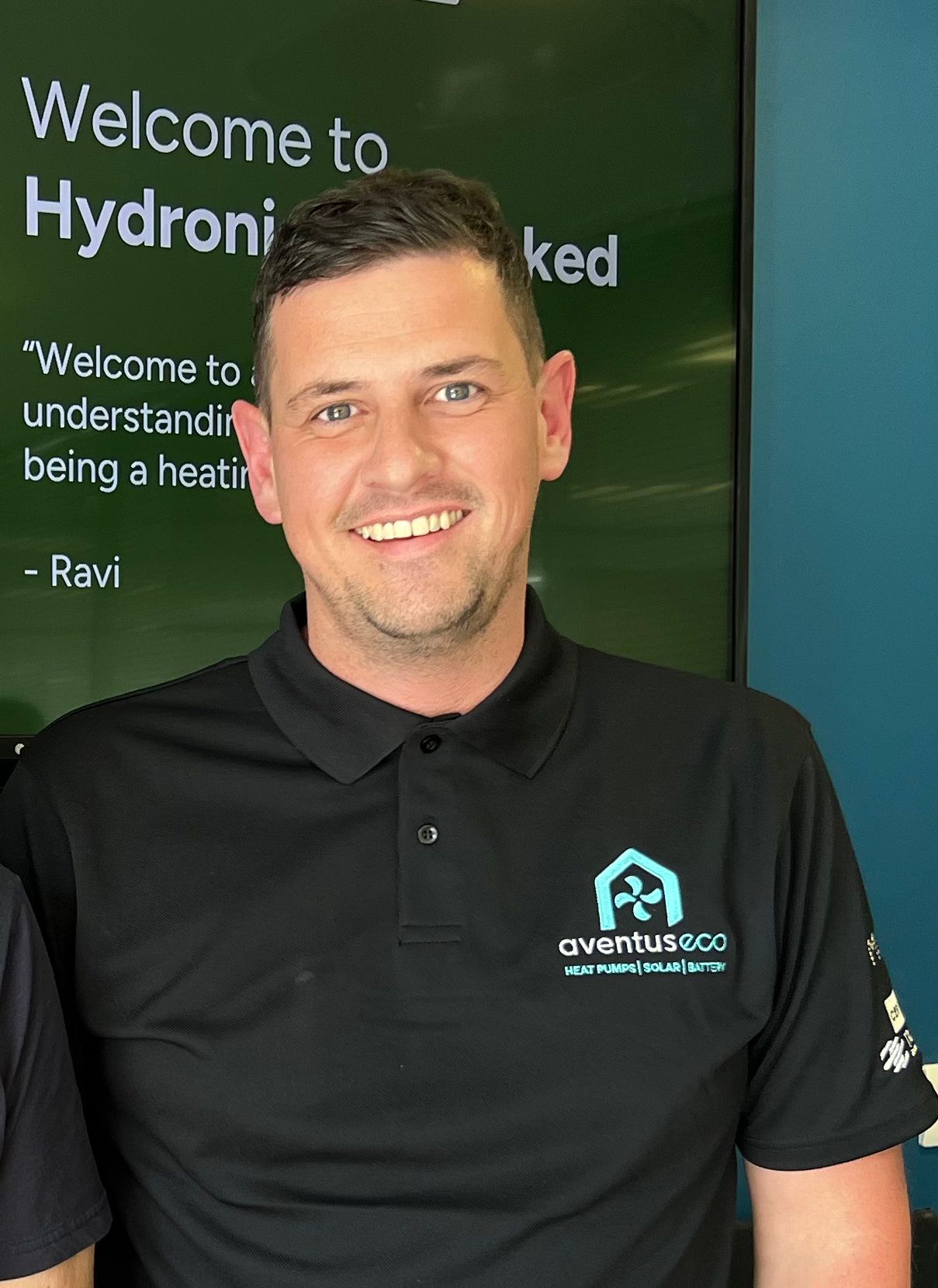
I’m the guy who was a Joiner by trade and founded Aventus Eco and have learned how to do heating design over the past four years. I’ve utilised my transferable skills to help me, for instance, using the knowledge of understanding how a building has been built – what walls will be best use to install products.
Last year I placed second at the Scottish Energy Efficiency Awards for Renewable Installer of the Year, and also won Best New Build Renewable Project of the Year at the same awards.
Following on from that, I then went on to win Best Speciality Trade at the Scottish Home Improvement Awards.
Extra training and/or CPD you’ve done in the past 12 months
I have recently been a participant at a round table with the Scottish Government on heat in buildings and ASHP. I am also a speaker at Midsummer Energy’s new trade show this year, as well as the Home Building and Renovation Show.
It is also worth noting that I am on track to be Scotland’s first independent installer to become an Octopus Trusted Partner for Zero Bills projects. We have the first few jobs due to be approved in Scotland over the next couple of weeks. Up until now it has mainly been large housebuilders delivering this type of project.
Please tell us about one or more projects you are particularly proud of
The project I would like to enter is a full system design and installation for an impressive new build project. For my customer – two architects, who are father and son – it was their dream build and it really is a Grand Designs type home. There is also a personal side to the story. The father sadly lost his wife as the build was starting, and she made him promise he would finish it. The new house sits on the plot of the old family home, which they had demolished to make way for the new property.
The new property is four bedrooms, two bathrooms with an open plan living, kitchen and dining area. My job was to review the architect’s drawings and then design a full heating and hot water system from scratch. Key to the customer was that the new system was an energy efficient as possible. The system I designed incorporated a heat pump, underfloor heating and solar panels to provide a renewable energy solution which would result in minimal running costs for the homeowner.
In terms of the customer’s other requirements, it was important that everything was designed to be hidden, including the heating system, solar, battery storage, and plant equipment. To accommodate this, I helped design a plant room which would be tucked away in a basement-style area on the lower floor, and we laid out the underfloor heating manifolds discreetly within cupboard spaces throughout the property. I designed all flow and return pipework to run under the building, with the remainder hidden through web joists back to the plant room. The aim was a clean finish throughout, with no visible compromises. The pipe sizes were 28 ml and were all copper – no plastic, because its more robust.
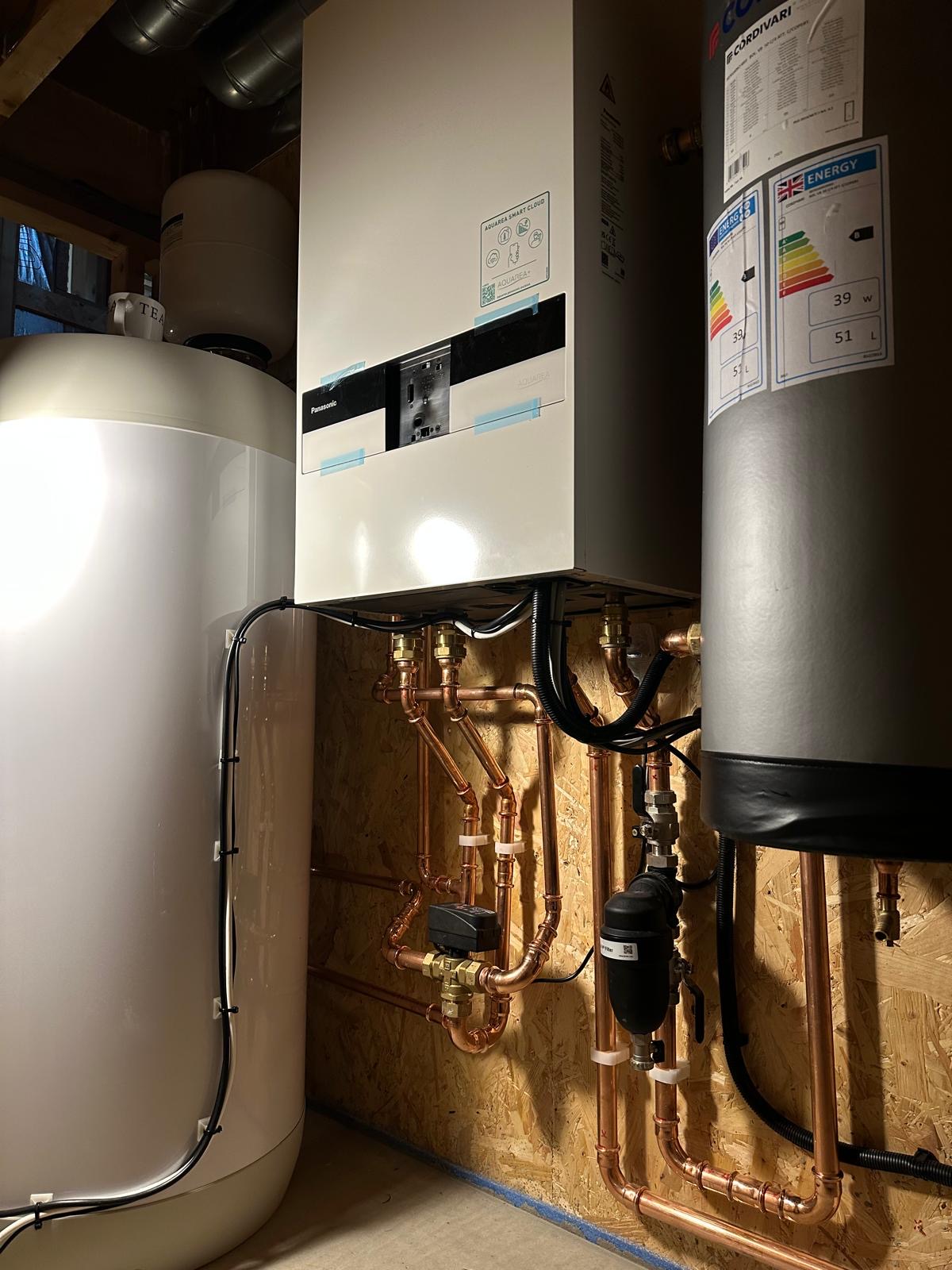
From a technical point of view, the biggest challenge was the extremely low heat loss, around 2.5 kW. Because it is a future family home, hot water performance needed to be right. We could have selected a 3.5 kW heat pump based on heat loss alone, but hot water reheat times would have been too long. We therefore selected a 5 kW Panasonic heat pump that can modulate extremely low and still deliver strong hot water performance. It is a unit I have used multiple times and I trust it for this type of low load, high specification build.
Which products did you select for the job and why?
The heating system is based around a Panasonic 5 kW L-Series heat pump with the internal bi-block unit. This model was chosen due to its very small indoor footprint, modern appearance, and excellent modulation range, which is critical on an ultra-low heat loss new build. The internal unit houses the circulating pump, a compact expansion vessel, and the backup heater, keeping the plant room layout clean and efficient. It also represents strong value for money without compromising performance or control.
Although the space heating heat loss was extremely low, hot water demand for a future family home was a key design consideration. A smaller unit could have met space heating alone, but hot water reheat times would have been compromised. The 5 kW Panasonic allows very low modulation while still delivering reliable domestic hot water performance.
The solar PV and battery storage system was also fully designed and installed by my team. The roof is standing seam, with a strict requirement that the solar installation be as visually discreet as possible. Panel layout and mounting were selected to minimise visibility while maintaining performance.
The underfloor heating was installed by Next Level Underfloor. I chose them to install as the job was quite large, and they have the equipment to do it, I work with them on any larger jobs as I trust them. The UFH was an open loop system, and the brand of the UFH and Manifolds were Horstad.
The system utilises a Fox hybrid inverter paired with the latest EP12 battery, alongside 10 Aiko Gen 3 solar panels rated at 480 W each. These panels are currently among the highest performing available on the market. The system was sized specifically to meet the requirements for a 10-year Octopus Zero Bills solution, noting that the same programme is typically limited to 5 years on retrofit projects.
One of the main technical challenges was routing DC cabling from the roof across three floors down to a basement plant room. This was completed while maintaining compliance, accessibility, and a clean architectural finish throughout the property.
All heat loss calculations were completed using Spruce to accurately size the heating system. Solar performance and financial modelling were carried out in Easy PV to assess energy generation and cost savings. The system is configured for load shifting, meaning it is designed to use and store electricity at optimal times, such as when solar generation is high or energy tariffs are lower, to reduce running costs and improve overall efficiency.
The project took around three months to complete, including the design phase. In terms of maintenance, we have linked up the system with SMART tech, so we can monitor the performance of the system and quickly spot any potential issues, or advise the customer to adjust settings if needed.
We also added the customer to our ‘EVENTUS ECO FAMILY CHAT’ a private individual group chat, where our heat pump customers have unlimited access to ask our company questions quickly if/when any arise (and receive Instant/ fast replies).
Tell us what was different or unique/challenging
I worked closely with our underfloor heating partners to design the entire UFH system from first principles. Pipe spacing was set at 100 mm, 150 mm, and 200 mm depending on room heat loss and usage, with the whole house designed as a single open zone. The system is open loop with no buffer or additional circulation pumps. The only pump in the system is the heat pump itself, keeping hydraulics simple, efficient, and loss free.
One of the most satisfying aspects of this project, and all new builds of this type, is the ability to design everything from scratch. I can see every heat pump we install on the backend, similar to an Open Energy style view, and I actively monitor and tweak each system for weeks until it is performing exactly as intended.
On this particular project, the system was running continuously for around 40 hours at a steady 18 Hz compressor frequency, drawing roughly 1 amp, with an average flow rate of around 9 litres per minute. External temperatures during this period were averaging between 2 and 3 degrees. The system would have continued longer, but hot water production interrupted the run. The operating graphs were completely flat, showing stable, steady state operation with no cycling. The system has only been running about 4-5months, so there are no yearly measurements yet.
System water volume was designed at approximately 20 litres per kW of maximum heat pump output, ensuring excellent thermal stability. No underfloor heating loops exceed 85 metres in length, maintaining balanced flow and low pump effort throughout.
This same design approach is now being replicated on similar new build projects, with one currently underway in Edinburgh and another upcoming in Glasgow using an almost identical specification.
Tell us what you learned and what you may do differently/apply to a job in future
This project reinforced the value of designing the entire system as a single, integrated solution rather than a collection of individual components. Having full control over heat loss modelling, emitter design, hydraulics, controls, and electrical integration from the outset allowed the system to operate exactly as intended, with long, stable run times and extremely low electrical input.
One of the key lessons was how critical early coordination is on ultra-low heat loss new builds. Decisions around pipe routes, plant room location, floor build ups, and service zones have a direct impact on system simplicity and long-term efficiency. On future projects, I will push even harder to be involved earlier with architects and structural designers so these elements are locked in before construction progresses.
The project also confirmed the importance of designing for domestic hot water separately from space heating in low load homes. While space heating demand was minimal, hot water recovery times still needed careful consideration. Selecting a heat pump with a slightly higher capacity, but excellent low-end modulation, proved to be the right balance and is something I will continue to apply.
From a commissioning and optimisation point of view, the job highlighted how valuable extended monitoring and fine tuning is. Allowing systems to run for long periods, analysing live data, and making incremental adjustments over weeks rather than days results in far more stable and efficient operation. This has reinforced our approach of post-installation optimisation as a standard part of every project, not an optional extra.
Overall, the main takeaway is that simplicity, correct sizing, and early design involvement consistently deliver the best outcomes. These principles are now embedded into how we approach all future new build and high- performance retrofit projects.
We have a further 30 heating pump installs booked for the next 7 months and 8 currently in progress, so we plan on taking as many learnings as possible forward on to these projects. We upload educational content onto our you tube channel for out customers.

Qualifications
Extra training and/or CPD you’ve done in the past 12 months
Please tell us about one or more projects you are particularly proud of
One project I am particularly proud of involved a complete replumbing and installation of an air source heat pump system in a Grade II listed property measuring approximately 240 square metres, with 4 bedrooms and 3 bathrooms. The house was originally heated by 2 open fireplaced at either end of the house. The customer did a temporary fix with an LPG boiler and 4 radiators to heat the home the best they could.
The property was particularly complex because it was effectively two buildings from completely different periods joined together. Half of the house was built in 1960 using brick and block construction with a tiled roof and no cavity insulation, while the other half dated back to 1780 and was constructed using traditional cob walls almost half a metre thick, with a thatched roof and very low ceilings.
This created significant challenges when designing an efficient heating system, as the two sections of the property had very different thermal characteristics and heat loss behaviour.
From the outset we advised the client that an air source heat pump combined with underfloor heating would provide the most consistent and efficient way to heat the home, particularly given the size of the property and the varying building materials. Air source heat pumps are the most consistent and efficient way to heat a house, and the customer wanted to step away from fossil fuels. A heat pump was advised as air con would have been an uncomfortable heat for the type of property and didn’t suit the house due to the more destructive installation requirements.
Installing the underfloor heating required major structural work to the ground floor. The building contractor had to jackhammer the original floors, install a new sub-base, insulate the floors correctly, install the underfloor heating pipework and then reinstate the original flooring. This allowed us to create a modern, efficient heating system while preserving the character of the historic building.
However, underfloor heating was not possible upstairs. The existing floor joists were not structurally strong enough to accommodate the additional weight and build-up required, so we designed a system using radiators on the upper floor instead.
A key challenge throughout the project was accurately calculating the heat loss across two very different building types. The 1960 section had to meet modern heat loss targets of approximately 0.18 W/m², while the 1780 cob construction behaved very differently thermally. This is because the 1960 section was insulated to 1960 standards and the builder had the option to go ahead to get the building up to regulations with current heat loss requirements.
However, for the 1780 section, new building materials we used in the 1960 section wouldn’t have worked properly, as mortar was made out of Lyme, so it needed to breath. We used up-to-date traditional methods of rendering; using Lime render and lime flooring (Instead of Celotex for instance).
The walls of the 1780 section were so thick and the walls were made up of flint, brick, mud etc, which provided a big thermal mass, so it created a natural radiator. To improve efficiency in the older section of the house, we used sympathetic materials suitable for
heritage buildings, including insulated lime render and limecrete flooring with an insulated sub-base. These materials allowed the building to retain its breathability while improving thermal performance, which is essential for older cob structures.
Because of the complexity of the property, we calculated the heat loss three separate times to ensure accuracy. As we are not MCS registered, we worked with an accredited umbrella provider to review and manage the final heat loss calculations and system design, ensuring the system met the correct compliance and performance standards.
The system itself operates as a fully weather-compensated open loop system, meaning it
automatically adjusts flow temperatures based on outside weather conditions. This allows the heat pump to run at the most efficient temperatures throughout the year, maintaining comfort while reducing energy consumption. The heat pump was located near the workshop just outside the 1960 section of the house, because it was really close to the cylinder, and it was where the customer wanted it.
This project was particularly challenging because we were effectively designing a heating system for two completely different buildings within one property, each requiring different approaches to heat distribution and insulation.
The project took around two years to complete, largely due to the scale of the work and the complexity of working within a Grade II listed structure while preserving its original character.
The final result was a fully integrated heat pump heating system combining underfloor heating and zoned radiators, delivering consistent, efficient heating across both the modern and historic sections of the home.
This project stands out to us because of the level of technical planning, heritage-sensitive materials and complex heat loss calculations required to make the system perform effectively across two very different building structures. The finished system provides the customer with efficient, future-proof heating while respecting the historic fabric of the property, which was the primary objective of the installation.
Which products did you select for the job and why?
We selected a Vaillant 12kw air source heat pump. In our opinion this is the best on the market without breaking the bank (Viessmann or Stiebel Eltron would have cost a lot more). I did provide the customer with all three brand choices, and we decided on the Valliant. I believe it’s the best on the market because data shows online that it consistently performs and does what it says on the tin. The breakdowns are minimal and customer services are quick to react if there is a breakdown, which is great for the customer.
We chose MHS Decoral radiators for their I-output and Ambiente underfloor heating, also for output and material quality.
Copper and MLCP was used for the carcass. Copper for aesthetics and MLCP as it is easier to fit without compromising of system performance.
The controls used were Senso Comfort, the standard controller provided with the Valliant heat pump. I chose this because it is so easy for the customer to use and it was fully weather comp, so it communicates with the unit to decide on the best flow rate within the parameters I set.
All products selected come with ongoing technical support from the manufacturer and suitable warranties to give the customer peace of mind. They were all chosen with the customer to suit their aesthetical and heating demands.
Tell us what was different or unique/challenging
The most challenging part of this project was accurately calculating the heat loss across such a unique property. Because the house was made up of two completely different building types, getting the design right was critical to ensuring the system would perform properly.
I initially carried out the heat loss calculations myself twice, and then worked closely with our trusted partner, to review and verify the figures. There was a lot of back and forth between us to refine the design until we were confident the system would work efficiently across both sections of the building.
That process was incredibly important, because once installed the system needed to perform reliably in a property that was never originally designed for this type of heating technology. The building itself also presented challenges during the installation. As we opened up floors and exposed the structure, we occasionally had to adapt the pipework layout and underfloor heating design to suit what we discovered.
What makes this job stand out to me is that it felt like the kind of project every heating engineer trains for but rarely gets the opportunity to deliver. It allowed me to use everything I have learned about system design, heat pumps and heat loss calculations on a property that many would consider too complex for an air source system.
The end result has been extremely rewarding. Despite the building not being originally designed for a heat pump system, the installation is running exceptionally well, delivering strong efficiency and consistent heating across both parts of the house. The customer had very high expectations and has been extremely pleased with the outcome, which makes the project even more satisfying.
Tell us what you learned and what you may do differently/apply to a job in future
This project taught me a huge amount and really strengthened my confidence as a system designer and installer. The biggest learning point was around heat loss calculations and the importance of validating your design when working on unusual buildings. Completing the calculations myself and then working with our partner to review and confirm them gave me confidence that my approach was correct and reinforced the value of collaboration when tackling complex projects.
It also pushed my understanding of air source heat pump design further than any project I have worked on before. Designing a system that could successfully heat two very different building structures required careful planning, flexibility and a deep understanding of how the system would behave in real-world conditions.
Another important lesson was the need to remain adaptable on site. With older buildings in particular, you often uncover unexpected structural details once work begins. Being prepared to adjust pipework layouts or heating zones while still maintaining the original design intent is a key part of delivering a successful system.
Overall, this project allowed me to apply everything I have learned through my heating training and practical experience. In future projects I will take forward the confidence it has given me in designing and installing heat pump systems, particularly in more complex or older properties. It has shown me that with the right planning, collaboration and attention to detail, even buildings that seem unsuitable for modern heating technology can achieve excellent results.

Qualifications
Extra training and/or CPD in the past 12 months
Please tell us about one or more projects you are particularly proud of
The project that stands out for me this year is a very large domestic job. I was contacted by the owner of a beautiful 1000m2 property in Sheffield [city]. The house is huge with six bedrooms and eight bathrooms across four levels, complete with an indoor swimming pool and spa area. It had been owned by a steel manufacturer originally.
Part of the home was built in the late 1800s but has been renovated over the past five years with an additional extension built on. It had four floors from a basement up to the top floor which is this amazing observatory and guest suite!
It was a family home, their forever home, that they wanted to be future proofed. Their aim was to make it cheaper to run in the long run (which to them meant ideally no gas), and they wanted it suited their lives – for example they have electric vehicles so needed an EV set up. So put simply, the owners wanted a renewable solution to their heating system.
Every project I take on tests me, but with this one I had to find solutions I’ve never come across before.
The original builders had wanted to fit gas boilers which the homeowners didn’t want. Because of this, they then went out to try to find a solution that would work for them. When I arrived, they had already had three different options presented to them – one for 100kw of gas installation, one for biomass and one for a 120kw ground source installation. They didn’t go for biomass as they just weren’t too keen when they heard more. They didn’t go with the ground source because of the scale of the install and also the cost (they’d been quoted around £60k+ just for the bore holes).
They got in contact with me via a referral from OSO. The homeowner had contacted OSO as he was interested in the products, and OSO recommended he speak to me. It’s a great example of manufacturers working with installers for the benefit of homeowners.
The issue we had was providing a solution that was cost effective, efficient but would ultimately provide comfort to the whole house. I had a £100k budget to work with, including the pool area and labour costs etc. With a property this size and the scale of the job, there could be no wastage and everything had to be bang on with no room for error.
The reasons they chose my suggestion included the fact that the plant room I recommended would be smaller than the other suggestions, I could bring it under the budget, there would be less load with my system so in turn bills would be lower. It was also the renewable tech they were looking for.
I worked on the job for four weeks, with other guys on site too.
Working with an existing design
Unfortunately, I couldn’t start from the beginning. This was because they had moved in around four years ago and had already had some work done. Some of the system had already been planned out and couldn’t be changed, I had to make my designs fit into the existing ones. But, I like a challenge!
An example was with the underfloor heating which had been specified and fitted, as well as some of the hot water plant having already been installed. Unfortunately the UFH had been installed differently to how it should be – all rooms have the same centres but different floor coverings was just one problem – so it hasn’t optimised space in the way it could.
The system I designed had to cope with this – I did this by fitting a bigger pump.
Tech
I had to provide a solution that would integrate with the customer’s home built KNX system (KNX is a home automation app which controls a whole home from the lights, speakers and curtains to heating, hot water and more. This ultimately leads to lower energy consumption) to allow localised control over all aspects of the job, temperatures, rooms that were heated, hot water control, secondary pump control, load shifting and so on. This can all be controlled through the homeowner’s phones, the way they wanted it.
The load was 41kw for the house, from two heat pumps, and a separate pool, shower area and spa area had a load of 40kw which I achieved by a heat pump/gas boiler (hybrid) system.
Which products did you select for the job and why?
We selected 3x Heliotherm r290 units in a cascade of two and then a separate hybrid cascade for the pool and heated area. Heliotherm was chosen because the customer wanted something premium, and something that ticked all the boxes. The footprint was also perfect as we already had limited space on the base so at 1m2 they just worked. I did a previous job with this heat pump brand so I knew how to install the units. It has controls that allowed me to connect it to the KNX easily.
The units allowed us to bank two heat pumps together for the house and then add another together with a Viessmann 100w boiler for the pool in a hybrid set up.
Planning it out was quite challenging as I had never done this size of project before but when you get into it, you are only move water and heat after all – just with bigger pipe. The basic principles stay the same so it was a case of working steadily through it. I worked out the load, sized the pipes, selected the pump, sized the buffer, and finally commission it correctly.
The most challenging bit was working out how to control the hot water side of the system. We had 2x 800 Oso maxi coils that the customer had already chosen themselves. These were sized for max demand, but most of the time the house would only have two adults and two children. I knew that meant I had to work out how to control these coils, which you’d usually see in commercial jobs but were necessary due to the size of the house.
With the client using KNX I also wanted to make sure he had access himself so just levers weren’t going to cut it. I came up with an idea to use zone valves but then had to make sure they were approved for use on potable water.
The solution I found was to use two times zone valves, have each heat pump doing a cylinder each and then just control what was heated when and closing the zone valve to the cylinder which wasn’t being heated. We could then alternate run times and use legionella cycles.
The secondary return pumps only supplied certain areas of the house, so I ensured this could be controlled so that the heat loss was kept to a real minimum. By setting it up like this, it meant it would only pump water around the zones needing it, and also only through the one cylinder that was open to be heated.
The heating was loaded into a buffer via both heat pumps, set up in a lead and lag type format. One will load and then bring in the other one when it’s needed. The KNX allows the customer to keep rooms at base temperature and then just bring temperature up in rooms when needed.
Tell us what was different or unique, challenging or just especially satisfying about this job?
The uniqueness was because the property is vast at over 1000m2 yet only has four lived in members. I had to provide a solution to heat the home and hot water when they need it, but also be able to provide the ability to close off the heat and water at times when there’s no demand – otherwise you’re heating and providing hot water to this huge area for no reason.
This needed a lot of planning and thought as you’re balancing the most efficient system with the way the homeowner needs to use it to be budget efficient too.
The cascade allowed this as in times of load it will just run one unit and modulate down. The 850l buffer will allow some storage, which means that only rooms that are being used will have the temperature raised. This will lower kW usage and save on costs.
Even though performance is crucial, on something this size the energy used is key. I’ve been able to reduce this greatly which will save a lot of money for the customer. This was key to the design – I needed to spend time thinking about it – not just spending lots of money on an install without it ticking all boxes.
It is currently running (October to February 2026) at just under 400% efficient 3.8 COP.
Pool – the house has an internal pool which required heating – I took a hybrid approach to this. This was for a couple of reasons:
So, I added another Heliotherm [heat pump] and I also fitted a Viessmann 100w gas boiler for the hybrid set up.
The customer is using the hybrid option in a different way to standard. By using the KNX system we can load the buffer for the pool by whatever fuel source is costing the cheapest at the time, It’s likely that this will be gas in the winter and the heat pump the rest of the year.
Blending valve – I also fitted a blending valve after the buffer so that during times of low energy costing, we can load the buffer at a higher temperature and create more volume allowing off hours when energy is more expensive.
Hot water can also be loaded in times of off peak too.
We are also running this from one pump, this pump was from the customers old system, instead of purchasing new, we reused.
Solar – there is currently a large solar array installed at the house, but no batteries are connected up to it as this job on the customer’s list to do in the future. When the batteries are added to the system this will again allow more shifting. When they are ready, we’ll get this working to give them an all encompassing system!
The satisfaction of this job was from knowing that I provided a solution that hit the brief and that is as efficient and cost saving as it comes.
Tell us what you learned and what you may do differently/apply to a job in future
This was a big learning curve.
Designing a system that someone else had started to create was something I’ve never done before – it involved bigger pipes, bigger pumps, bigger heat load. Just looking at the house on plans was terrifying itself!
It was my first time being involved in pool heating too, so if I take any experience away from this, it’s that this was an invaluable learning. How I achieved and solved the hot water situation was something I just didn’t know before.
Next time, I would possibly go fixed temperature from the heat pumps, varied by the KNX system and use an Esbe blending valve after that with weather compensation so that we could maximise the buffer store, off peak charging and maximise recovery.
Apart from that I’m more than happy with what we have done and it has made me really proud. It’s a nice feeling!
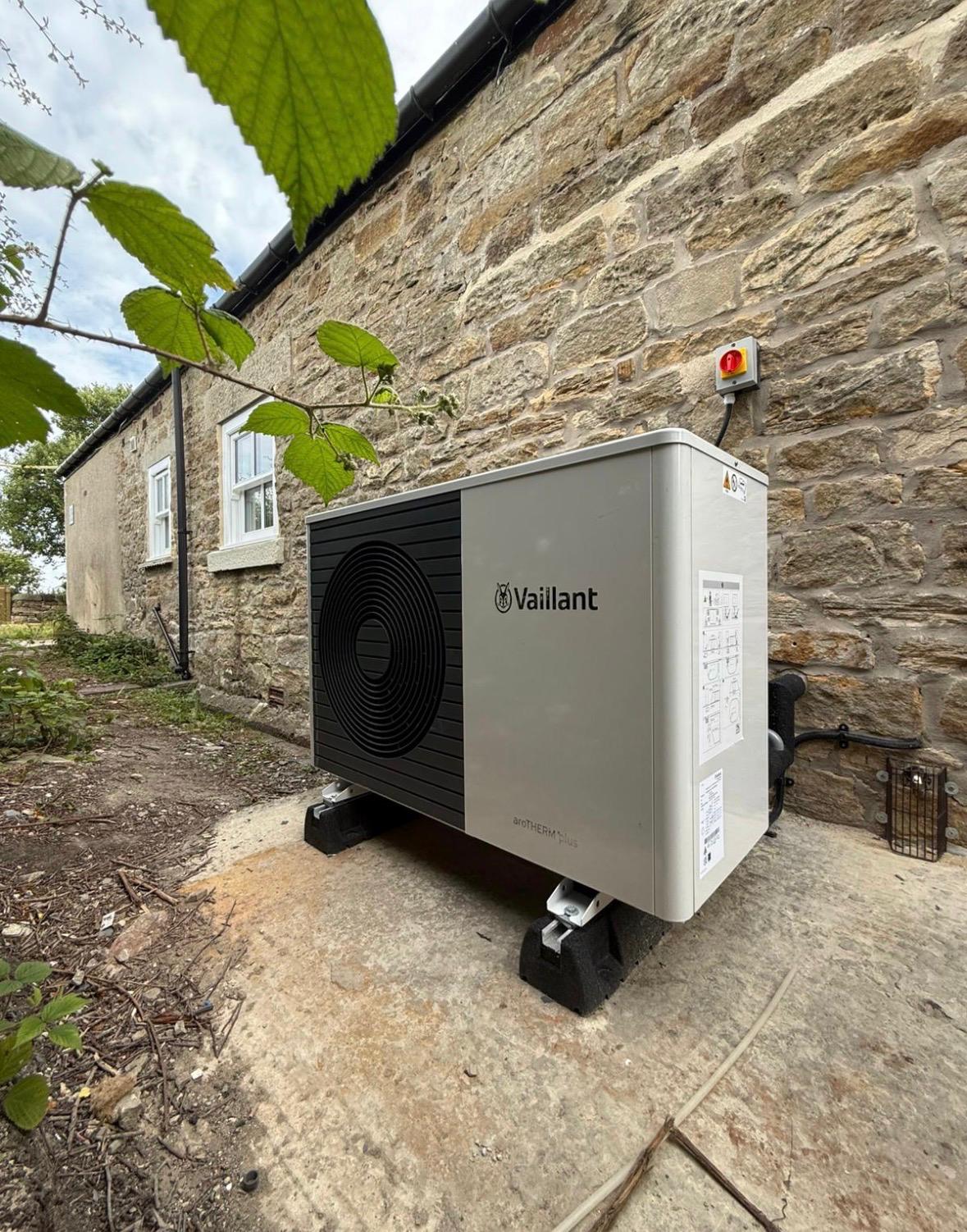
Qualifications
Extra training and/or CPD you’ve done in the past 12 months
I regularly re-train and keep up to date with what is new (etc) and also keep up to date with trends and industry standards via online learning and newsletters from industry leaders like CIPHE, MCS and Gas Safe publications as well social media and Installer Show.
I am part of the North East Low Temperature design group which is a peer-to-peer learning group started by Craig Gilhome and now has many industry leading engineers from the North East. Alongside peer-to-peer learning this group offers valuable insights and real-world experience in both designing and fitting or maintaining systems which are often complex and where sometimes there is no ‘one way’ to design, therefore a broad knowledge is required. We often have manufacturers come along and offer specific training.
This year I have refreshed my manufacturer training with Vaillant mostly concentrating on control systems and the new heat pump range. I have conducted the online Steibel Eltron training and visited its training center for heat pump and control training. We have also successfully passed our annual assessments with MCS and NICEIC without any remedial work.
On top of this I have joined a Northumbria University “Help To Grow” management course which is a Government partly subsidised course and has provided a steep learning curve to help our business excel and further educate us on subjects such as marketing, customer satisfaction, employee engagement and leading change, business planning/models etc.
Please tell us about one or more projects you are particularly proud of
I would like to enter a project that on the surface appears fairly straight forward, however the project started with a request to heat a disused farm building as part of a home refurbishment, where the client had originally wanted to replace an oil boiler with another oil boiler.
Part of the challenge here was to get the client to see that using a new oil boiler as a replacement was not the only way forward, and that there are more efficient and sustainable options available. I was able to show them the benefits of using a heat pump by showing them first the heat loss calculations and then introducing insulation to walls and floors, and essentially modelling the difference the improvements made to the heat loss to each room, which I was able to demonstrate with our h2x package (I did it manually first and then check on H2X software).
The client took this inspiration on board luckily, and actually then took the insulation levels further and agreed to running the heat pump as an open loop system with the zones removed. We were able to provide accurate calculations and a lower flow temperature as a result, and from here sized all the pipe work, correct DT emitters and flow rates using CIBSE calculations and checking with h2x.
The client settled on our advice and used a heat pump as the sole heat source and concentrated on minimising the heat loss of the building to make it as efficient as possible.
The client is really happy with the resultant use of a renewable energy with the associated green credentials and with low running costs highlighted through the recent cold period. These are both outcomes that could not have been achieved by using a conventional oil boiler and the client has commented that our design feels more in keeping with a modern countryside which we totally agree with.
Which products did you select for the job and why?
I used a Vaillant Aurotherm Plus heat pump, as the heat source, with the hot water provided by a Vaillant cylinder, and control provided via the Vaillant weather compensation. We were initially asked to look at a Dakin system as the client had an old quote that they had and subsequently dismissed, but had set their mind on in terms of an approximate budget based on this unit. I evaluated the performance of the Dakin unit and felt we could offer more performance for a similar budget by choosing a different product.
I chose the Vaillant heat pump as we felt this was the best product in terms of both budget and suitability for the house. I have used Vaillant many times previously and feel they offer really good training/support and I also have extensive product knowledge as well as real world experience of how the products preform. This I feel is a key part of design, as its based upon our experience and promise to the customer. We were confident we could turn our design concept into reality, delivering the results our modelling demonstrated to provide customer satisfaction.
The heat emitters were Stelrad k3 along with k2 radiators which we find great quality. The radiator valves selected were EPH valves, again because we really like the quality. All the pipe work was copper with pulled bends. We chose copper as the resistance is better and it suited the client’s aesthetical requirements. We often choose Lawton Pipe. Insulation was Primary Pro externally, and Armaflex lagging self-sealed internally. We fitted the heat pump using Inta Anti-freeze valves with the unique snorkels. The unique snorkels prevent dirt and debri getting into the system, as the hole is at the top. We chose this system as we needed to provide an anti-freeze solution and these items work well as a set – and the valves fit directly onto the back of the heat pump, as well as look great for the customer.
In terms of planning, most of the project was completed away from site following the original heat loss visit and client meeting. From here we produced the schematic drawings overlayed over the building plans, with pipe routes and sizes etc, and we then just fit as per the plans. We mark-up any amendments before re-checking and submitting final ‘as fitted’ plans back to the end user and client.
Tell us what was different or unique/challenging
To us, the first challenge was to set out a viable case for the customer to consider a heat pump as a renewable source over the oil boiler, as the client had heard varying press reports of poorly fitted expensive heat pumps etc. I think it’s satisfying for both myself and the client when we work through a design and show the maths behind it in a simplified transparent way, which shows the results we can achieve. The simplicity in the design here is really that it works well and is not overcomplicated, so is really easy for the client to control and use. The icing on the cake is that we achieved this with a renewable source and the running costs are lower than projected! Predicted heat pump performance was 4.03 MCS SCOP HEATING and achieved a SCOP of 4.52.
Comparative costs of the oil boiler the customer originally asked for would far more expensive to run, with the heat pump offering an annual saving of approximately £550 per annum whilst being sustainable and avoiding the volatility of oil prices. This was the best choice.
Tell us what you learned and what you may do differently/apply to a job in future
I did have a battle with the index circuit, and I needed to figure out how to sufficiently heat the bathroom, without using the towel rail that the customer wanted. I worked with the customer to find a suitable alternative that met the heating demand of the room, but also, the customer’s aesthetical requests.
In future I would like to combine a project like this with solar and battery storage. This is because they all work great together as a renewable source, and are a great way for properties to become self-sufficient and be less reliable on the grid. I would possibly also introduce heat recovery to further reduce the overall heat load.
I want to encourage and educate (not preach) customers that oil boilers are not the way forward, especially with rises in price.

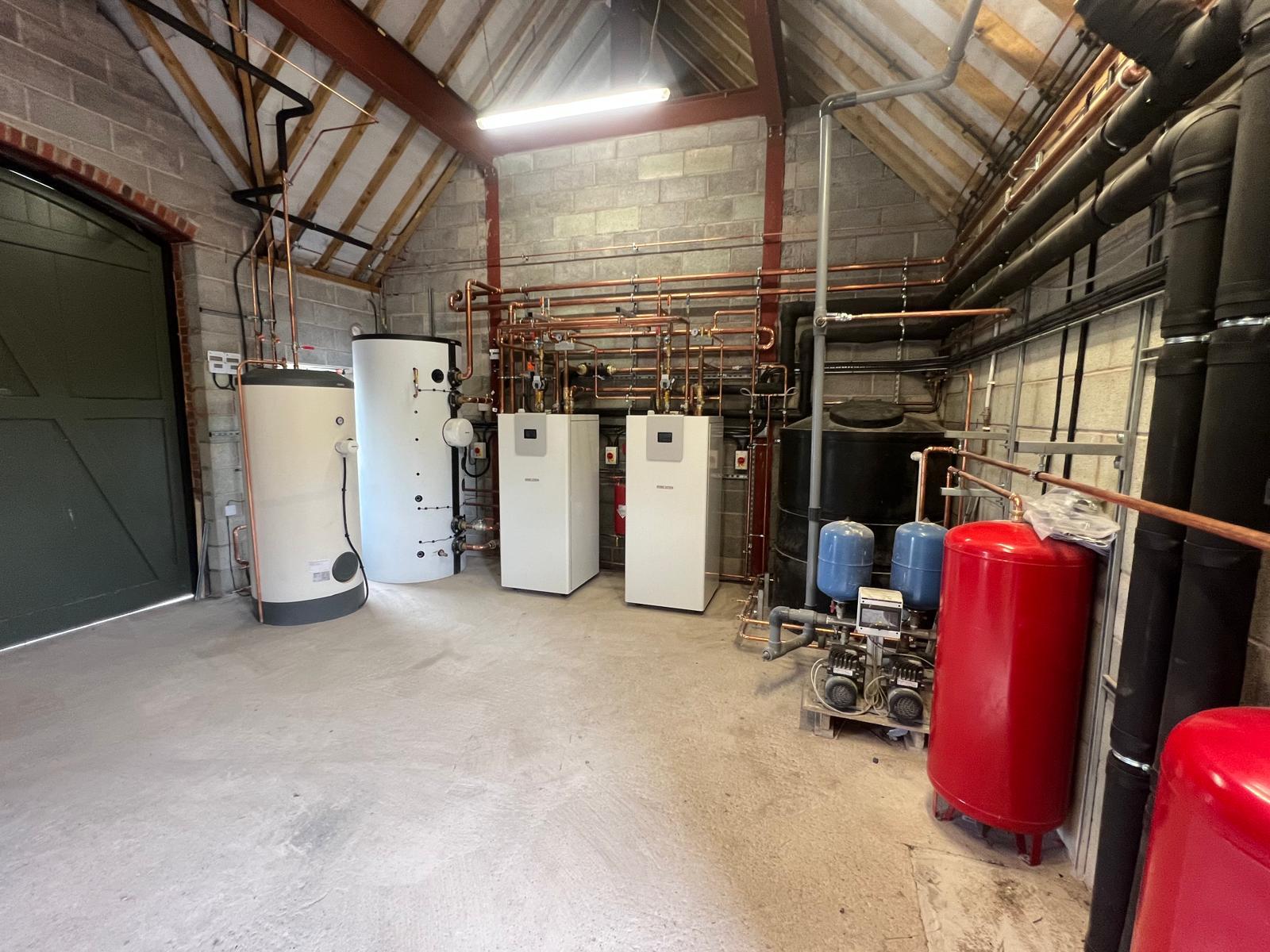
Qualifications
Extra training and/or CPD you’ve done in the past 12 months
Please tell us about one or more projects you are particularly proud of
A project that I am particularly proud of was located at a stunning 18th Century Grade II listed family home. It is nestled in the heart of the [area] North West Midlands, in the picturesque Staffordshire countryside. Surrounded by rolling farmland, tranquil woods and charming historic outbuildings. It offers a perfect blend of heritage and natural beauty. The main home was habited by 2 people, which had 5 bathrooms and 6 bedrooms. It had 4 floors overall including a cellar. The customer found us through a previous customer who recommended our specialities in renewable energy.
The property was special, as it wasn’t the only one on the land, it was also surrounded by two cottages, office spaces and conference rooms. The ground was being used to study trees, so it was split into 2 parts, research and a wood yard (Chopping and sending of trees). The homeowner was very keen to explore renewable energy and improve their environmental footprint, especially as the old system was an old Biomass system that wasn’t installed very well. It broke down a lot, and the customer had huge lead times between fixes.
It was a standout project for many reasons to us, not only due to its size and scope but also because of the careful consideration given to preserving the estates existing character. Every step was taken to ensure the modern systems integrated seamlessly with the historic elements, maintaining the integrity of the property while embracing sustainability. I worked closely with the estate manager and the family at every step, collaborating on every decision to ensure a seamless blend.
There weren’t any major problems, just a few obstacles that required us to adapt our original plans and find solutions along the way. Given the scale of the project, I had multiple subcontractors and suppliers involved, which meant careful planning to ensure everyone was in the right place at the right time, including the DNO [power lines] and the install of new electrics. Coordination was key to keeping everything on track and ensuring the job ran smoothly from start to finish. I also had to carefully specify the system to suit and integrate with the existing cast iron radiators throughout the main house.
I had to adjust the position of the ground collector and ground loops when I encountered hard rock during excavation. This unexpected challenge required some rethinking of our original layout, but I was able to adapt and find a solution that kept the project on track. The solution was to cut 5% of the extra 20% of pipework we usually leave for future changes, a little shorter to accommodate.
As the grounds were so big, we didn’t need to dig bore holes. Instead, we routed 4000m pipes in the ground on 20 different trenches at 100m long, one meter apart and deeps. This was a less disruptive and cheaper option for the customer.
I also adapted the layout of the plant room by removing some of the original internal walls because the original way it was arranged was with an old chip store for boiler, so we knocked it through. We reconstructed them to house the new installations creating a clean, unified layout to ensure that regulations for spacing were met. This also allowed for improved access for future maintenance and servicing.
To ensure as minimal heat loss as possible we specced the job using the original building structure, and continued to track pipes through the property. We were aware it was an old house, so we were conscious not to disrupt anything we didn’t need to.
Which products did you select for the job and why?
I replaced a large, dated, biomass boiler that kept breaking down, with a highly efficient 66-kilowatt ground source Heat Pump system, powered by two 33 kilowatt Stiebel Eltron WPE units. We chose Stiebel Eltron for the quality and reliability of the product. It also met the requirements of the job; over 4000 meters of ground collector pipework were carefully installed beneath an adjacent field, harnessing the natural energy of the earth to provide sustainable heating.
In regard to the Ground Source Heat Pump system, I used products from a brand I trust and use regularly- Stiebel Eltron. Known for their reliability, ease of sourcing replacement parts and excellent technical support. Our local team are responsive and knowledgeable. Plus the remote monitoring is a selling point for end users, giving them peace of mind knowing I can track performance and any issues from anywhere.
To further boost efficiency, after agreeing with the customer to boost the efficiency of the heat pump, I installed 50 kilowatts of Solar PV across both roof mounted and ground-mounted arrays. This is complemented by 43 kilowatts of Solar battery storage in the plant room, ensuring a reliable and sustainable energy supply that maximises the system’s performance year-round. We mounted them and then subcontracted an electrician we work with regularly, to tuck it all in.
The system was filled with 1,500 litres of deionised water to enhance efficiency and effectiveness, because the old system was so dirty. This ensures improved temperature stability, reduced energy consumption for heating, lower maintenance demands and reduced operational costs, whiles also delivering environmental benefits through impurity free operation.
I incorporated a secondary hot gas system to increase the flow and return temperatures serving the hot water cylinder, thereby enhancing system efficiency.
The PV was dug in the ground, and then inputted into the plant room. Now all the installs work together, and are weather comp to create the most efficient flow rate for the properties.
Tell us what was different or unique/challenging
The size of the job makes it stand out, but personally, this project was one where I could take the lead in making key decisions and managing the site. It was the first time I was a main contractor on a job – I took a project management course to ensure all sub-contractors were managed properly. Our sub-contractors were recommended by us to the client, and they decided to use them. It was a hands-on opportunity to oversee the entire operation, to ensure that every aspect of the work met our standards as a Company and aligned with the estates vision. It was a rewarding experience to see the project come to life and know I played a key role in its success.
The system now provides both heating and hot water to multiple buildings across the estate, including the main hall, two cottages, office spaces and conference rooms. In total, it efficiently heats an area of 900 square metres, ensuring comfort and sustainability throughout the property.
In its first week alone, the solar system generated an impressive 572kWh of clean energy. Combined, the solar and the battery systems now supply up to 50% of the estates energy need, reducing CO2 emissions by 75%, or 5.4 tons. This has also halved running costs, paving the way for a more sustainable future while preserving the heritage of this historic estate.
Tell us what you learned and what you may do differently/apply to a job in future
What I learned was mainly centred around logistics and management. For example, I gained a better understanding of how access restrictions affect operations- such as which large vehicles could enter the estate and how lorries were unable to pass under certain bridges or use some of the roads closest to the property due to size limitations. As a result, the organisation of supplies had to be managed and timed carefully to ensure materials arrived when needed, while avoiding delays or access issues. This highlighted the importance of forward planning, coordination and effective communication.
In future, when installing a ground system of this size, I would ensure more test holes are conducted across a wider area before work begins. This would help identify ground conditions more accurately and prevent the need to change designs once the project is already underway.